Queering the Stage in Montréal: Chip City Inside Madpoetix Studios
When Happie Micha Edwards stepped onto the ‘Inside Madpoetix Sudios’ stage in Montreal, a backdrop of chip bags became an unexpected stage set. Through storytelling, dub-poetry, and audience interaction, they revealed how performance can expand the possibilities of spoken word.


Madpoetix Productions, based in Tiohtià:ke (aka Montréal), Quebec, Canada, is a performing arts organization founded in 2007 and one of the city’s longest-running spoken word / performing arts institutions.
We have produced a multitude of events over the years, beginning in 2007 with our inaugural presentation, the Art of Performing Aural Sex and in 2011, with the murder of one of Montreal’s pioneer hip-hop icons, Paul Frappier aka Bad News Browns, we formed the Soirées Intimes open mic series to honour our local and national artists today.
The PHENOMENAL 5IVE show took place at Le Belmont at 4483 Boulevard Saint Laurent (Sunday, February 7, 2016).
Madpoetix Productions revived the open mic night under the name: Inside Madpoetix Studios.
Drawing inspiration from the classic show Inside the Actors’ Studio by James Lipton, we interview the artists live following their performance and also allow the audience to ask our featured guests questions. This is followed by the open mic performers. So far, our audience loves this format, especially being able to interact directly with the artist.
We recently had the pleasure of bringing Toronto-based, Jamaican Bruk-Out storytelling artist Happie Micha Edwards to perform at our monthly Open Mic night.
Having known Micha for the last two years and experiencing their work mostly online, we knew he would be a great fit for our stage. Given that Micha is a queer artist, we reached out to another Montréal organization, the Massimadi Foundation, to explore a partnership that could amplify the presence of our feature into the city’s cultural landscape. Massimadi, which foregrounds Afro-Queer LGBT2S+ artists and filmmakers in Montréal, welcomed the collaboration with great enthusiasm. The partnership has already begun to generate momentum, opening possibilities for future events and continued exchange.
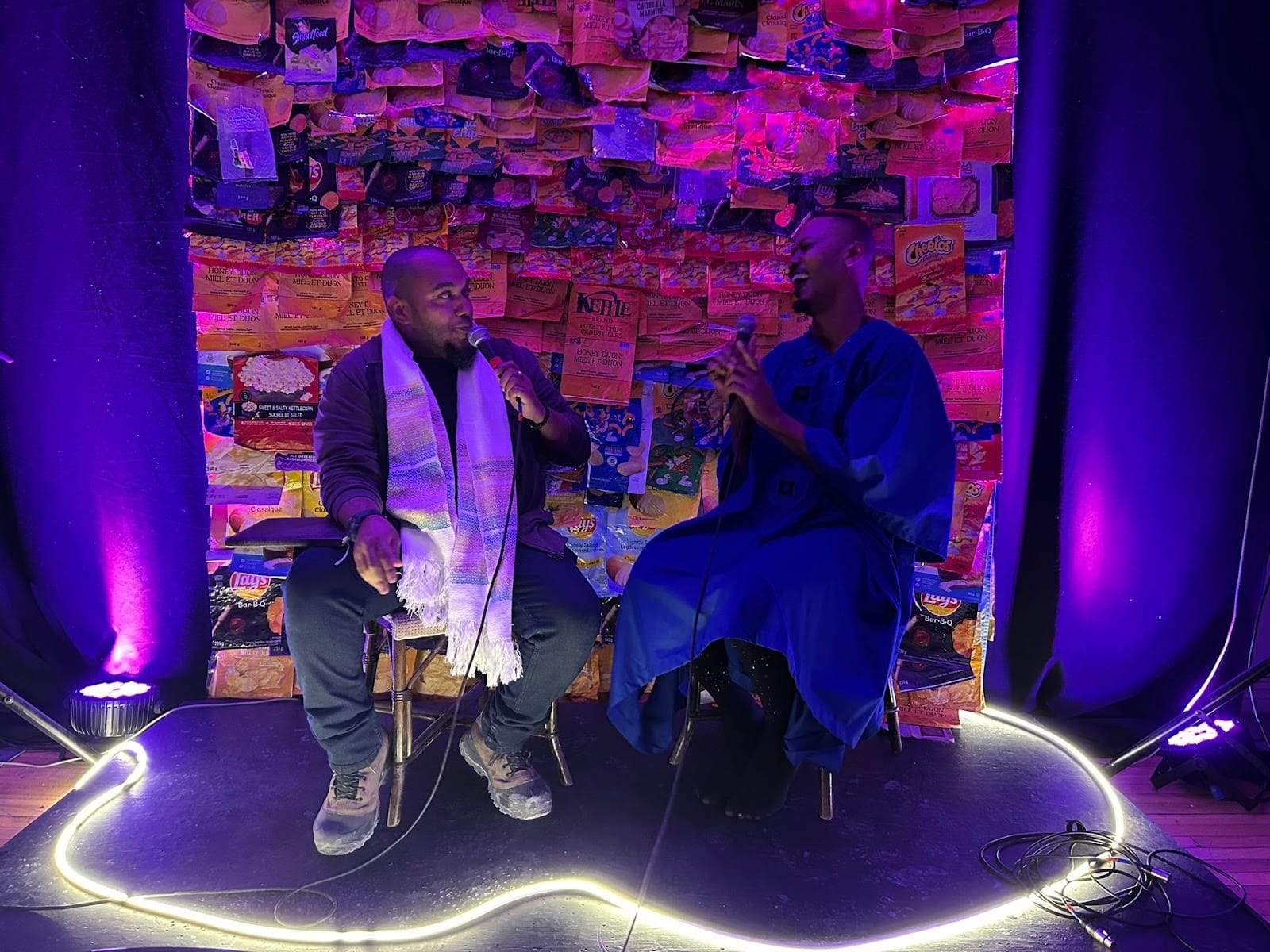
Nothing could have prepared us for what Micha presented and how they commanded the stage with grace, beauty, and raw Caribbean power and essence. Accustomed to featuring artists simply arriving at the venue, Micha transformed our simple stage into his theatre. With creative simplicity, they installed a backdrop of chip bags, then everything that followed made us realize we had witnessed a master at her craft.
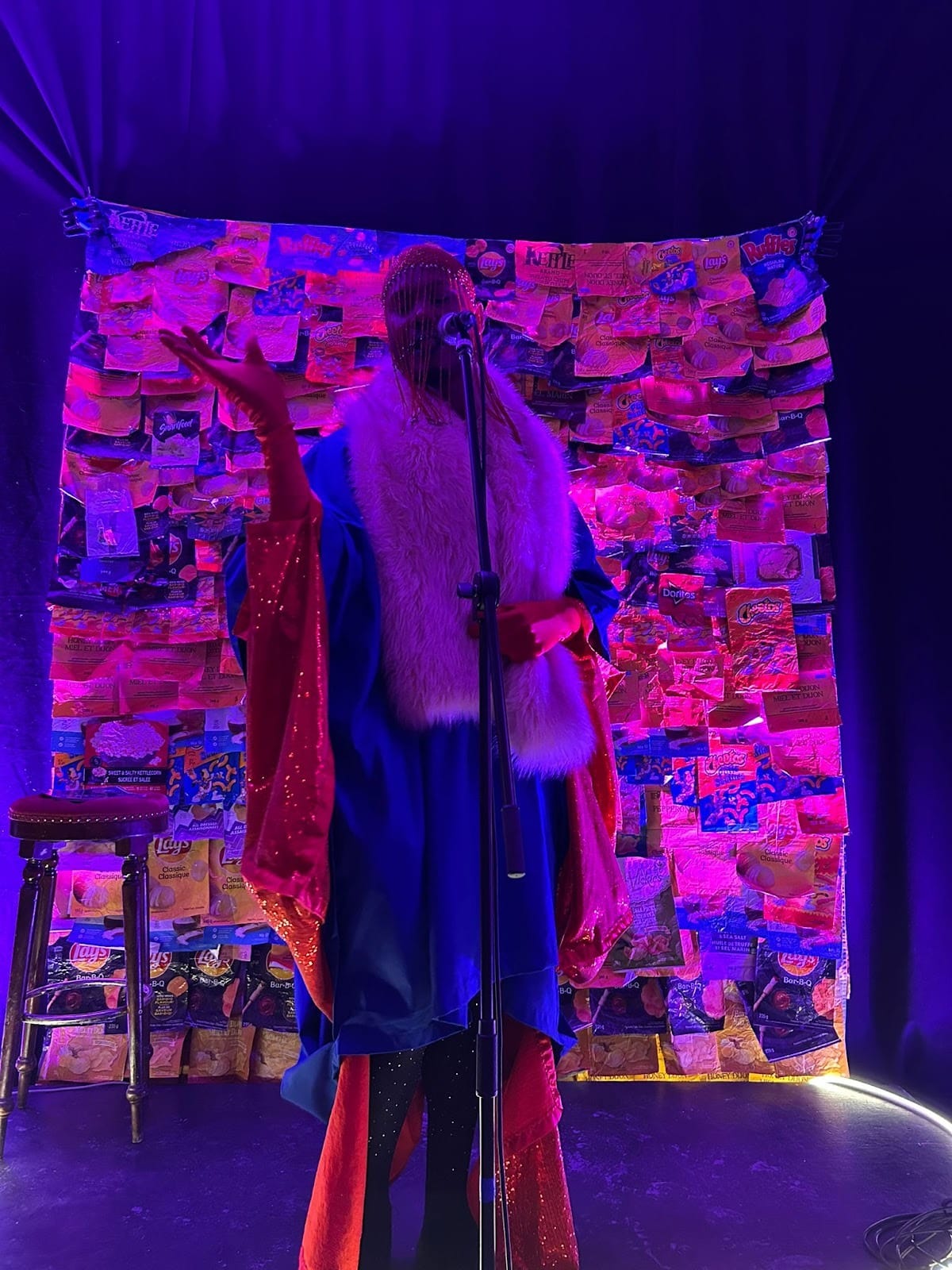
Aside from the costume design, which was multi-layered, Micha greeted every individual person at the venue, whether audience members, staff, or open mic artists.
Nothing can truly prepare you for a Micha performance, you just need to live it.
By the time they were ready to take the stage, they had us all in the palm of their hands. What happened next was the unquestionable interweaving of storytelling, audience participation, dub-poetry, musical accompaniment, and a slow burlesque-esque striptease.
So many layers to Micha's performance, the chip bag quilt, the costume design, and more.
And the backdrop that Micha set up? That was their set. An audience member was asked to come onstage and pick a piece of paper from among many in the backdrop—a “quilt” of various chip bags—that would dictate Micha’s performance.
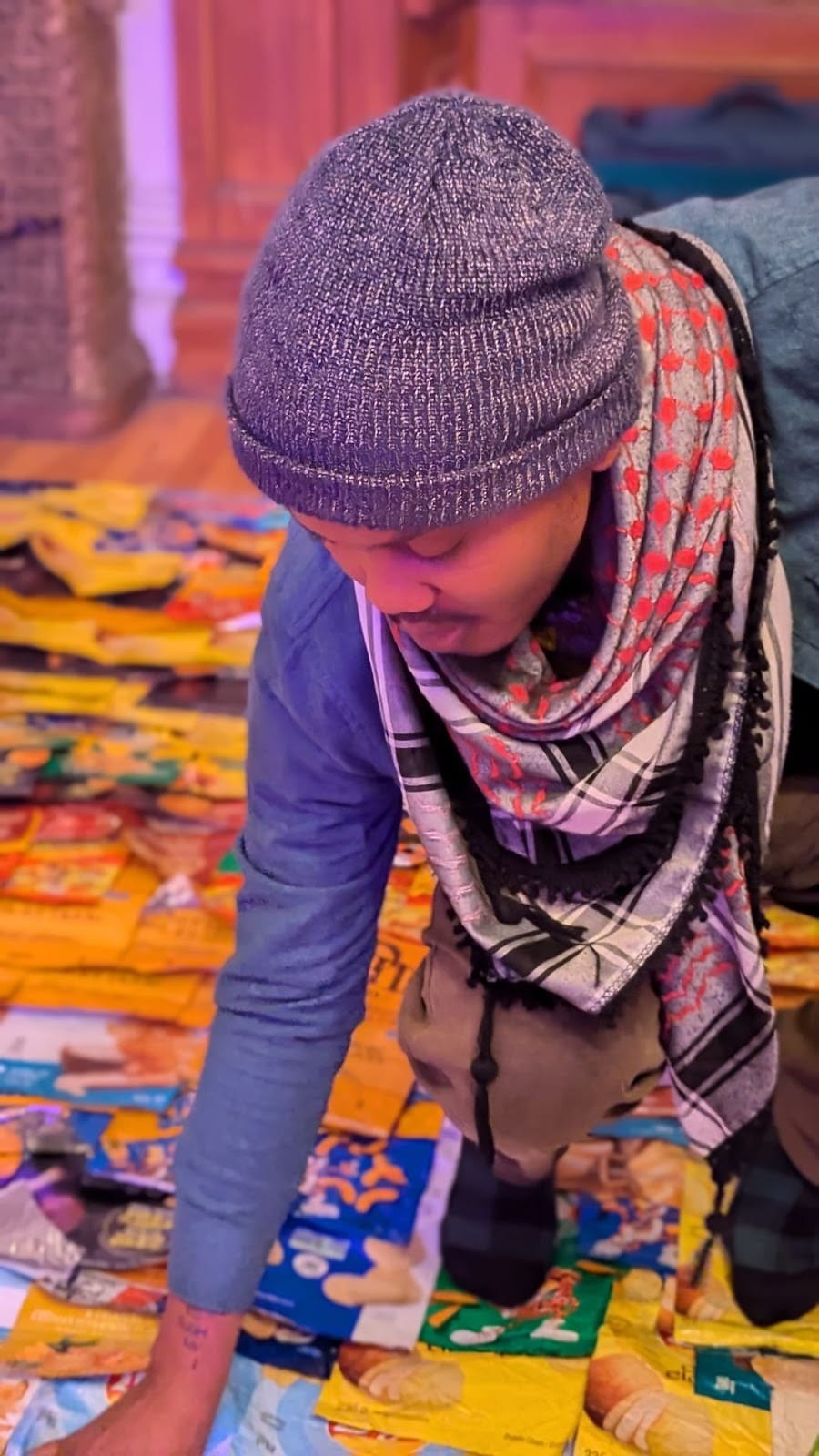
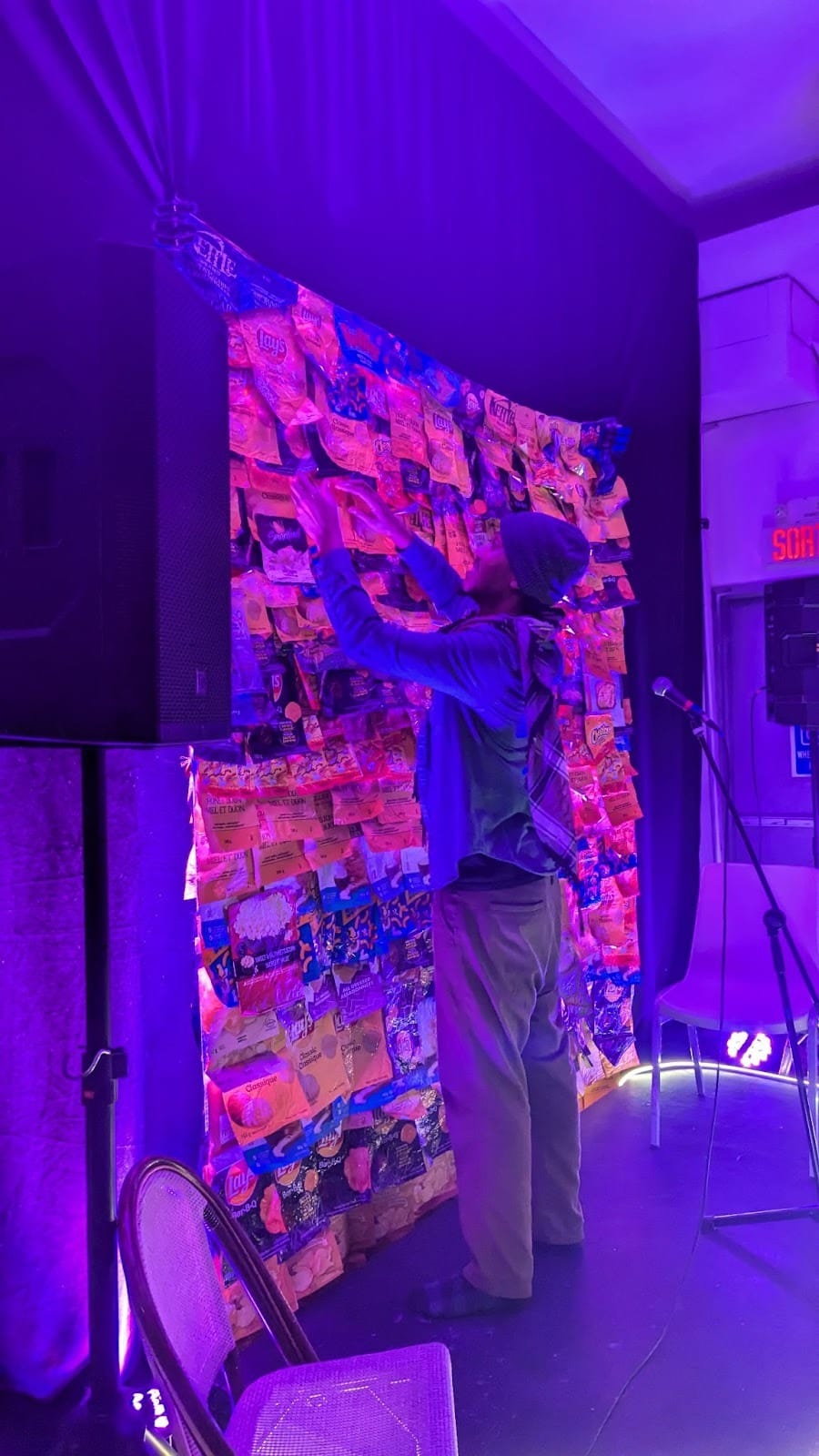
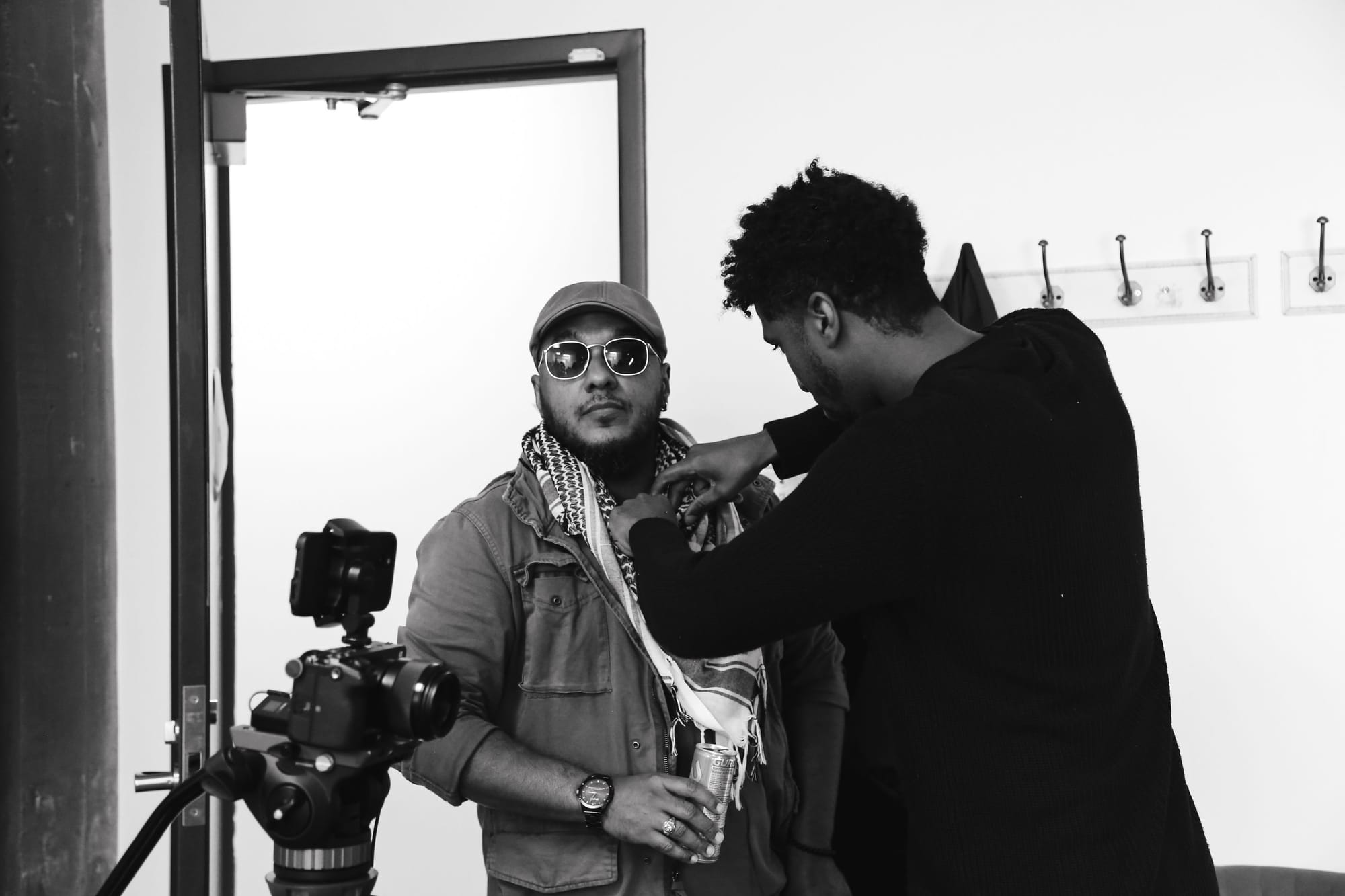
ON THE LEFT: Micha checks to ensure that the chip bags are connected to their satisfaction, and that the ‘quilt’ bares no significant flaws before installation, a testament to their attention to detail with this set piece. ON THE RIGHT: The stage, lighting and set at Maison France-Montreal lent itself to Micha’s performance. Here she adds the finishing touches, some notes that an audience member can assist her with the performance.
Micha has said in the past that the chip bags represent a deep gastronomical love of chips: the crunch, savouriness, and variety of flavours. But there was an unspoken subtext. Chip bags are not easily recyclable. Micha repurposed a throwaway item into art. Chips are owned by corporations, mostly owned by non-BIPOC folks, and having the bags displayed this way, supporting a queer BIPOC artist, was turning their purpose on its head. In African-American culture, quilting was used to document history, family lines, and more. Micha drew on our shared Afro-diasporan ancestry to revive an oft-overlooked element of profound historical significance.
Our Artistic Director thought he was a pretty good performer, especially in spoken word, but Micha showed him that the boundaries of his own work could be pushed even further. This interdisciplinary approach was insanely gorgeous and deeply inspired us. We will seek to push our own boundaries in a similar way.
As a Jamaican and Haitian, Kym Dominique-Ferguson, founder of Madpoetix Productions, understands all too well the complexities colonization has had on African-ascended people. Queerness has deep roots in African history. In The Spirit of Intimacy, Sobunfu Somé describes queer people as spiritual intermediaries:
“Gatekeepers are people who live a life at the edge between two worlds–the world of the village and the world of spirit. [...] The Gatekeepers stand on the threshold of the gender line. They are mediators between [...] genders.” (pp 131-132)
In many Caribbean countries, homophobia’s claws anchor deeply into the fabric of society. Jamaica is particularly known for its violence towards our queer community. Too often glorified through music and reinforced by the long-known buggery law:
Offences Against the Person Act (OAPA): Sections 76, 77, and 79 criminalize "buggery" (anal intercourse) "attempted buggery" and "gross indecency" between men, with penalties up to 10 years, 7 years, or 2 years in prison, respectively, often with hard labour.
What is missing from the description of this law, enacted in 1864, is an explanation of why it was introduced in the first place. Histories of slavery in the Americas and colonial Africa reveal that enslaved men and boys were frequently subjected to rape, a practice used to emasculate them and reinforce the absolute power of the enslaver. The buggery law emerged in part as a response to that trauma. Yet over time, it has taken on a different function. Rather than protecting bodily autonomy, it now serves to criminalize consensual relationships, transferring authority over intimacy from individuals to courts and the state. By openly supporting Micha in all their queerness, we challenge prejudices rooted in both fear and historical violence. What once was framed as protection has hardened into a legal structure that still restricts who people are allowed to love.
The reaction to Micha's performance was not universally enthusiastic. Shortly after the performance, a follower of our Facebook page responded to a post about Micha’s set with a terse: “We’re done.” When we asked what they meant, there was no reply. Moments like this reveal the contested space queer performance can still occupy in public life.
Art that invites vulnerability, pleasure, and fluid expressions of gender unsettles expectations about who belongs on a stage and what stories can be told there.
For us, the evening affirmed why spaces like Madpoetix matter. When artists such as Micha step onto the stage, performance becomes more than an event; it becomes an invitation to imagine community differently.
As the evening drew to a close, the quilt of chip bags still shimmered behind Micha like a patchwork constellation.
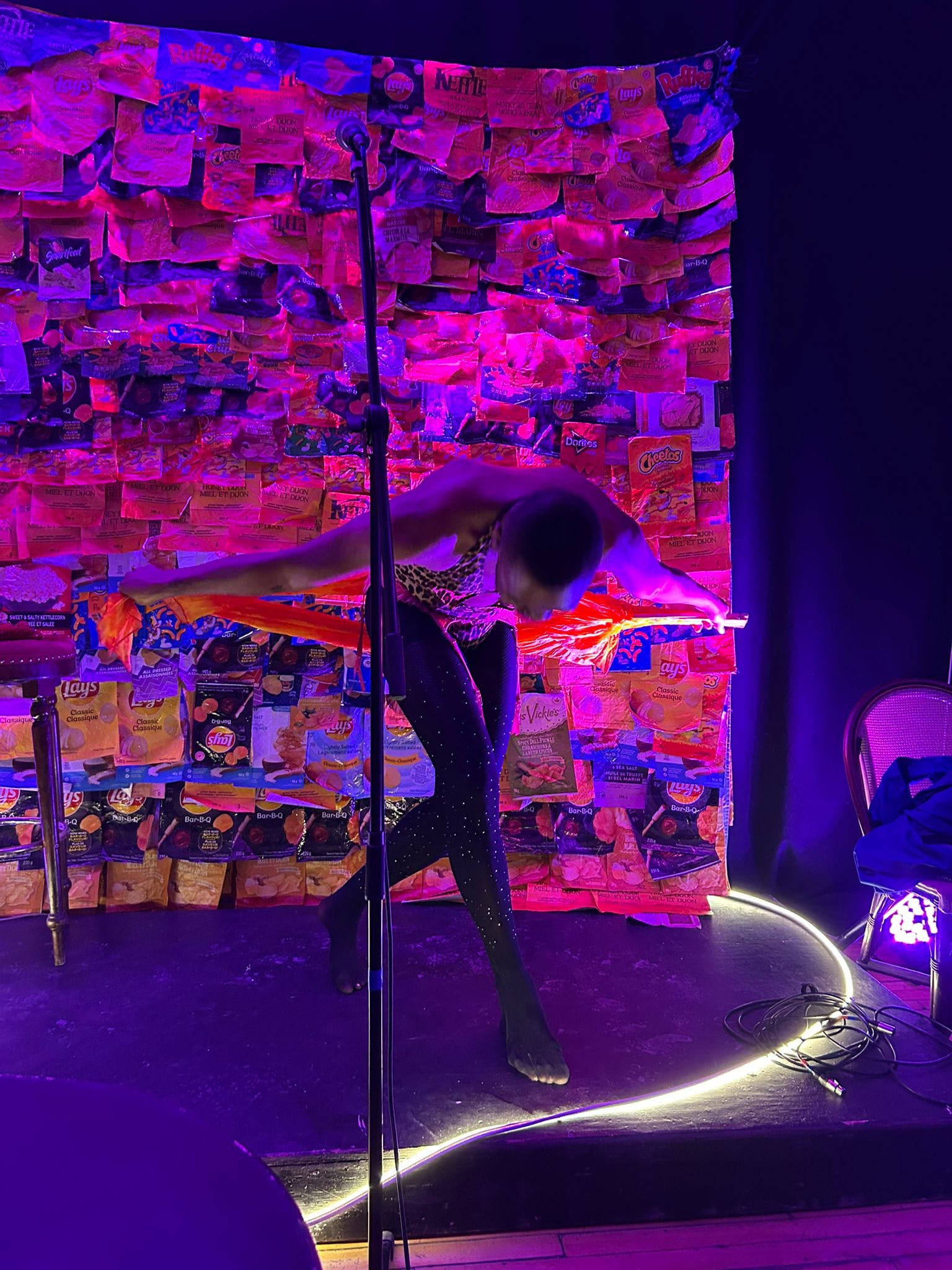
By night’s end, the stage at Inside Madpoetix Studios seemed to expand, the room widening to hold the many voices, histories, and possibilities that live performance, at its most generous, can reveal.
ABOUT THE GUEST CONTRIBUTORS
Kym Dominique-Ferguson is a Montreal-based theatre artist and spoken word artist. His plays, including the co-written BLACKOUT: The Concordia Computer Riots and the Canada Council-supported Dear Black Man, amplify Caribbean and Black narratives. As founder of Madpoetix Productions, he curates groundbreaking spoken word events like The Phenomenal 5IVE and Inside Madpoetix Studios, shaping Montreal’s performance scene. His work merges Caribbean oral traditions with contemporary theatre, creating visceral storytelling that resonates across communities. A graduate of Edna Manley College and Concordia University, Ferguson’s artistry lives at the intersection of page, stage, and cultural legacy.
Instagram: @mrkdferguson | @madpoetix
happie micha edwards (he/they/happie) is a self-taught interdisciplinary artist and Jamaican-born Canadian bruk-out touring storyteller based in Toronto. A student of New Thought metaphysics, he is an Ontario Community Changemaker alum, Black August Residency alum, and member of the Fellowship of the Griots. Their work weaves art, spirituality, food, and liberation. Trained at a premier culinary school, Micha believes whole, natural food is a birthright, while their primary practice lives in writing and live performance. They approach life on Native lands with awe, heartbreak, and curiosity.
Free to be—dem cah box we. Instagram: @happiemichaedwards