Àrokò Monthly Roundtable #05
What makes a home? A roof, a ritual, a memory, the people who let us be ourselves? And what happens when the world outside our walls begins to reshape what happens within them? In our latest Àrokò roundtable, we explore the homes that shape us and the worlds we create in response.


Each month, we gather members of the Àrokò Cooperative for an unfiltered roundtable, giving you a temperature check of our take on design as it moves through art, music, politics, technology, and everyday rituals of taste. We ask sharper questions about what’s being made, who it’s for, and what it’s really doing in the world.
“Ritual is portable. That's one way home enters the things we make.”
AISHATU
Welcome everybody to our monthly roundtable. Today’s topic is home. Given that we have our HOMEPLACE event coming up, it felt like the most appropriate topic.
What makes a home? What infrastructures are our homes being asked to make room for? Who wants to get started?
ZARIAH
I was reflecting on these questions, and there were a lot of feelings that came up. Especially today. Today is my father's birthday. And there are a lot of feelings colliding with this day and knowing that I have been no contact with him for almost two years now. Grappling with that fact and reflecting on my own home life, I think what a home or rather, what a home should be, for me is protection and safety, knowing that in my own experience home was not a safe haven.
And so now, as an adult, I want to go home and have that be a safe haven for me. The infrastructure of home for me is a space where I can truly let go and be myself. There's a guarded trust surrounding my home, not just in the physical sense but also in the spiritual, mental, emotional sense. Home doesn't necessarily have to be a physical place but can mean finding refuge and feeling at home in the people I'm in a relationship with, even in my car, which can be a semblance of home, especially as it connects to who I was and who I'm becoming.
Oh, and last thing, which is quite funny for me: I never turn the big light on in my home. Give me low lights all the way.
KELLYN
To piggyback off what Zariah was talking about, some of the things that came up for me, I genuinely wrote: what makes a home is me, my things, my items, my artifacts.
Home is a place that has room for my wholeness, for any given person's wholeness. It has the space to hold all of who you are, all of who we are. “Home is where the heart is” came up, obviously, because that is a thing that is felt. But my wholeness is also in the community of people around me.
I have moved around a bit in life, and always finding home in those places has helped shape the sense that there is no specific place that defines home. It's that “wherever you go, there you are” kind of thing. So even in transition, you need somewhere that is yours, somewhere that holds you in full. Maybe that's what our homes are being asked to make room for: all of the things that make you whole.
SHAKEIL
I grew up in a ton of different homes throughout my childhood, and in my adulthood I have been lucky enough to be pretty stable in where I've been living. Safety is the most baseline one, right? What makes a home is a place that is safe, and Zariah said that.
That is psychological, but it's also basic: if it rains, there is a roof. There is a place to sleep, whether it is a bed or a piece of the floor that has a mat on it. It is somewhere where you can safely eat food, whether it is out of a cooler or out of a refrigerator. There is a way to prepare that food, whether it is with a campfire outside or the five-burner stovetop. Those are the things that are most foundational to me. And then what really makes a home is the people in it. That's first and foremost.
MICHAEL
There's a foundational quote from my own childhood. I can never remember the author and I usually butcher it. Something to the effect of:
if you have no place you've decided to call your own, no matter where you're going, you're always headed home.
That is something I embody, and that also cohabits with my really deep and visceral connection to the city of San Francisco. But fundamentally, what makes a home is a space for ritual. You can define ritual however you want, whether it's the basic rituals of bodily function—sleep, eat, defecate—the larger, more spiritual connotations of time spent with the people you've chosen to spend time with or your family, depending on that relationship, or whatever rituals you have as an individual in the context of your community and your cultural milieu.
Broadly, if we take that approach to what a home is, then our homes are also being asked to make room for the rituals of others, the rituals of late capitalism, the rituals of surviving late capitalism, and market penetration and financialization reaching into just about every part of
our lives.
KRISTEN
A lot of what each of you has said resonates with me. I'll start with what Kellyn said about moving a lot. I moved to different parts of the country maybe seven or eight times within ten or eleven years. For me, above all, I've had to find home within myself. I loved what Michael said about home being a space for ritual. If I am my own home, then I have to create psychological, emotional and physical safety within myself and for myself.
That has evolved over time because being uprooted and taken to different places and put in such different situations can be so jarring. Finding a way to be centered within the self requires ritual and steadfastness. I agree that safety is paramount. I was fortunate to have a largely beautiful home life, but being far from the people who first gave me that feeling has also taught me that home can be found and made with other people.
AISHATU
I've been learning Arabic recently, and it has made me think differently about the word home. As a writer, I'm obsessed with language. In Arabic, one common word for home is bayt. It belongs to the same linguistic family as the word bāta, to spend the night, to stay somewhere overnight. I find that beautiful because it suggests something very basic: home is connected to where we sleep, where we return.
Then I think about German, one of my mother tongues. There is the word Haus, the physical house, and Heim, which carries more of the condition of being at home. In Hausa, another mother tongue I speak, there is gida. It can mean the house, but also the domestic unit, the people and relationships organized around it. So across these languages, home keeps exceeding the building. It becomes a relationship—to people, objects, routines, rituals, memories, languages, smells. Something we continuously make.
That also changes how I think about the question of what our homes are now being asked to make room for. As a technologist, I immediately think of AI. We tend to experience artificial intelligence as almost immaterial. It appears in a small window on a laptop or phone and can feel as though it simply lives there. But of course it doesn't. Behind that digtial window are data centers, electrical grids, water systems, undersea cables. For me, those infrastructures can become anti-homes, occupying the space of communities while consuming their resources, especially water. So domestic life is no longer simply domestic. It is entangled with infrastructures that may be far from us geographically but are still afffecting the conditions of our everyday lives. That raises another question: what gets displace or made invisible so that these systems can exist?
Let’s move to the next question. What do we carry from home into the things we make? How do our homes shape the way we design, create, and imagine even when we are far from them?
ZARIAH
Recently, I have been redoing my home. I got sucked into the millennial beige-gray-whiteness of it all when I first moved into my apartment. It was honestly symbolic of me not knowing myself, of not really having an identity, which is why my home originally felt so dark and dreary and didn't have any life in it. It didn't feel like me. As I've grown into myself and found assurance in that, it's transformed the way that I curate my home, the way that I design my home. It begins to bleed into other areas of my life.
I've granted myself the freedom to come alive in this creative renaissance of myself, to define what that can look like. For me, it's been accepting the quirkiness of myself and the very whimsical, fairy-like nature of the way I show up in the world, the weirdness of it all, the things that I like, and being able to invite that sense of joy and color and brightness into the way that I curate my house.
Now I see that same permission showing up elsewhere: in the work I make and in the way I present myself. As I've become more assured in my identity, I'm creating safety and protection because I am protecting the version of myself that I wasn't bold enough to be when I was a kid or a teenager. That changes the work too. It makes me want to create spaces where other people can be their full selves, where they can bring that authenticity into community.
SHAKEIL
The simple answer for me is: what do we carry from home into the things we make?
Everything.
You carry everything, whether you know it or not. I carry with me Seattle, Washington, and Northeast Portland and West Philadelphia and Germantown and the suburbs of New Jersey and Brooklyn and Jamaica and Stewart Island, all these places that have been home to me, to my parents, and beyond that. As someone who grew up bicoastal, it was always this question of, “Oh, you're from here, but you don't know this thing, so I guess you're not really from here.” That was my whole life for a long time.
But I carry all of it. No matter if I'm far from one, I carry that place with me. I'm looking out of my back window on a very rainy day and feeling the comfort of the rain, and I know that comes from Seattle. Even something as small as finding comfort in rain comes with me.
AISHATU
I totally agree that identity is home, right? So we carry it with us wherever we go. When I think of home, I think of Cologne, where I'm from. I have a very strong civic identity. I don't particularly feel drawn to saying I'm German or Nigerian, but I'm always happy to say I'm from Cologne.
Home for me is also connected to belonging to both the Hausa and Fulani communities. These identities overlap for me. Cologne has a long history of image-making. Growing up, I was surrounded by paintings, arrisitc stained glass of churches and objects in which gold carries both material and symbolic weight. I wasn't consciously studying that visual language as a child, but it shaped my artisitic sensibilities anyway.
At the same time, I'm deeply influenced by Hausa vernacular architectural traditions, Norther Nigerian Mosque design, and the treatment of surfaces, geometric ornaments, patterns, and color. When I visited the Emir's Palace in Kano this summer, I was struck by how architecture itself could carry that density of visual language. It made me notice how often gold returns in my own work. I've recently started experimenting with gilding techniques using 24-carat gold leaf in my visual art. What I carry from home into the things I make is the overlap between several cultural traditions.
MICHAEL
I can definitely relate to having a strong civic identity. But my civic identity does not come from having grown up in the city of San Francisco, but from having missed it my whole life. Listening to you, Aishatu, talk about your Cologne, it occurred to me that my San Francisco is very much a San Francisco of the mind, less based in the physicality of it.
I remember when I moved back here in 2016, having a very existential moment in Bernal Heights, which was the neighborhood I was born in. I woke up and smelled a smell I hadn't smelled in what felt like ever. I've never been able to quite understand what that was, and I've smelled it a few times since, but it connected with something deep in me that has very little to do with where I spent a large part of my childhood, which is a funny contradiction. But San Francisco itself is a city of the mind, and it means so much to so many people who have never been here or have been here only fleetingly. Maybe there's a fitting overlap there. So again I come back to ritual. Ritualizing anything is how I go about homemaking.
KRISTEN
I'm bringing everything from home into what I make. I have experienced deep care in my original homeplace. Care has been modeled for me. Outside of my home, I experienced something very different. That motivates me to show up with that care because it's ugly outside. So I try to build that care into my work. I want people to feel safe. I want people to feel seen. I've had experiences where I didn't feel either, and I know the difference it makes.
KELLYN
I echo a lot of what's been said already. So much of who we are is informed by the things around us, the things we experienced, the things we were taught, the ways we were raised. Our constructions of home, and therefore the things that we make and do, can be because of that, in spite of that, or in response to it. Home informs the things that intrigue us and our instincts about what a space should feel like.
Going back to what Michael and Kristen said about, I think those are the things that become designed and can be carried from place to place. Ritual is portable. That's one way home enters the things we make. Maybe this is me getting metaphysical again, but that sense of home within oneself that Kristen was talking about, if home is wholeness, and what makes me whole is all of the things informing me and the people that have shaped me and helped me become who I am, then all of that comes out onto a page or whatever it is I do, however I move, whatever I wear. It shows up.
[INTERLUDE: Jeremy joins from the kitchen, one hand occupied with chicken wings and the other reaching for the computer. Domestic life enters the conversation literally.]
JEREMY
Everyone's spoken really well about what home is and how we carry that. There's something poetic about what you said, Aishatu, about the shared family of the Arabic word for home and the word meaning to stay overnight. I've always had a hard time sleeping, because it's the most vulnerable anyone can be when you're resting.
There's something to be said about home as a place of rest and a place of peace. As an adult, I find myself interrogating what it means to build that for myself, feeling that in some ways I had that as a child, and in other ways I didn't. In the things I make, I try to bring forth a world in which I can find peace and rest for myself and hope that maybe someone else can too, or that it might at least spark something that helps someone else find theirs.
AISHATU
Let's move to the last question: What would it mean to design a homeplace?
If a homeplace is somewhere people can experience belonging, care, safety, memory and possibility, what must we protect, refuse or create in order for such places to exist?
SHAKEIL
Jeremy, your point of being able to rest and not be on your guard feels really pertinent. It has to be a place where you can rest and not have to perform, not have to be on guard. That's the biggest thing if you want to create a space where possibility is endless. That's what must be protected.
Something we've all been circling around is being free of judgment, which ties into safety. You can wild out in your home and say crazy things sometimes. And if you're with the people who are your home, they'll check you on it or expand your mind about it. I feel like I'm home when I'm talking to you all. It's a place of comfort, and it allows me to grow. There's that lack of judgment and also accountability.
MICHAEL
It's that rest and ritual component. You can't do ritual without rest. That's something we overlook, because all that ritual space comes from a place of being centered, being rested, being safe. I definitely echo you, Shaq, on feeling at home with you all. The ritual of sitting down at my desk and logging on with the homies to solve at least one of our problems for the day is something I've really come to appreciate.
As we think about the work we're going to do in Philadelphia, we have to make a homeplace for ourselves too. This project will be a success by any number of metrics, but I would argue that the most important one is whether the people who come to the space feel that it has been a home for us in its making.
AISHATU
When I hear the word homeplace, I think of something slightly different from a home, because a home can be private. A homeplace feels more collective. Somewhere where you can arrive and feel that there's space for you, space for your history. That's actually a very difficult thing to design because belonging cannot simply be designed by putting the right objects in a room, right? I don't think you can manufacture belonging as an aesthetic. So for me the question becomes: what do we protect and what do we create in a homeplace?
The first thing that comes to mind is memory. A homeplace needs memory. It needs the traces of the people who were there before us, their stories, their rituals even. We have to create a place where people can encounter each other, where care is not an afterthought. Care has to be part of the infrastructure of the homeplace.
So maybe designing a homeplace is about designing conditions of relationality. A homeplace translates to: Something was here before you. There's room for you now. And there's also possibility here for you to imagine a future.
KELLYN
The first thing I had written was: designing a homeplace breaks out of the individual and goes into the collective. As you were talking about that shared construction, I started to think about the dance floor. Specifically, queer nightlife.
There have been nights, specific events that are constructions of a homeplace, where a community gathers and the space becomes a ritual space. You're there to release the things you've been holding. That makes homeplace collaborative. It asks what we're holding together and what we're protecting together. At the largest scale, our collective home is this earth.
How can we design a place-specific, collaborative space that has room for memory and safety and care? What does that look like?
It looks like being able to show up as you are and release the things that may have been tough, even just for a moment, the traumas you hold. When I think about what we protect, I think about protecting our joy. That comes from being in Black, queer, and trans club spaces and having those be some of the really fundamental, designed homeplaces. Music and dance and the rituals of those things can make intentionally crafted, designed homeplaces.
KRISTEN
When I think about protecting the homeplace, I think about protecting folks' dignity and humanity. Something else that came up for me is that creating a homeplace requires stewardship. Any physical space is going to require stewardship. It's going to require a custodian.
If you're creating a communal homeplace, that also requires attending to it, having a regular relationship to it so you can understand what needs to adjust or be recalibrated or repaired.
[INTERLUDE: The conversation turns personal. Shakeil says HOMEPLACE is bringing together two homes in his life: Àrokò, and the Philadelphia family and city that raised him. He shares how much that convergence means to him. Zariah answers from the other end of the conversation’s arc. She began by describing home as a place where she had not always felt safe; making HOMEPLACE with this group, she says, feels like building one with family from the ground up. For a moment, the project they have been trying to design is already happening between them.]
AISHATU
I'd like one of us to briefly explain the project we've been referring to, for readers who might not know about it. What is HOMEPLACE for us specifically? Why does this specific word mean so much to us?
MICHAEL
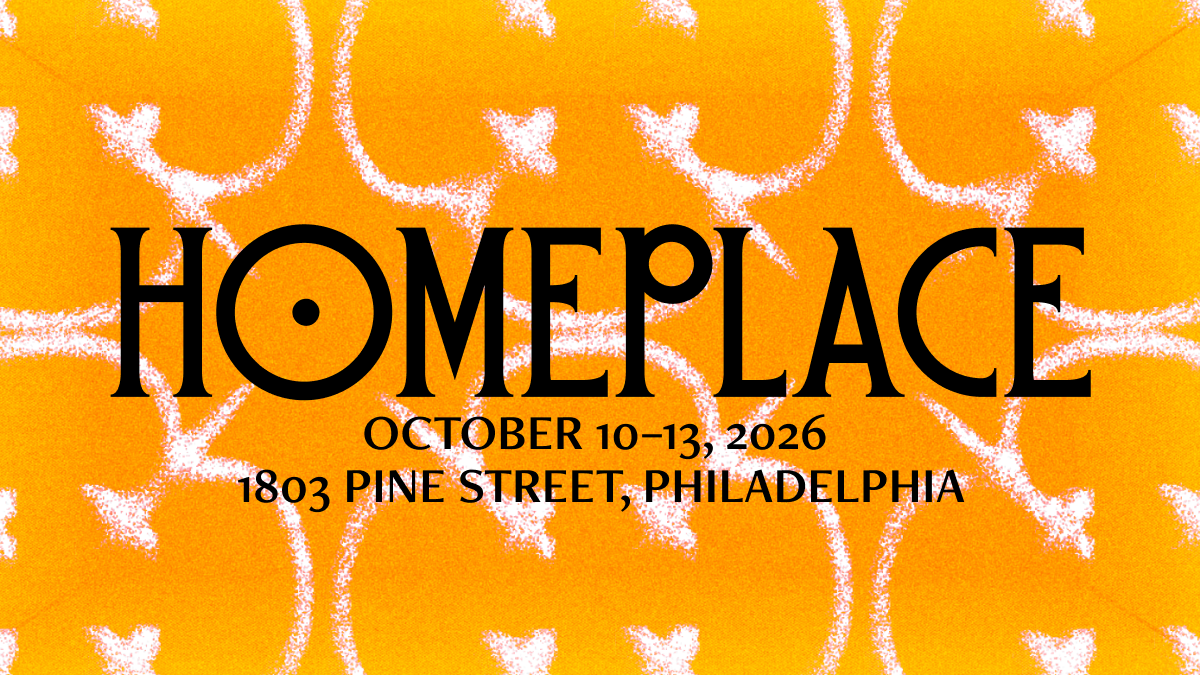
HOMEPLACE is the name of a four-day public exhibition that we will be debuting in Philadelphia at the beginning of October, at the tail end of Philadelphia Design Week. Organizationally, it represents a high watermark for us.
It is inspired by the title of a bell hooks essay, where we took it from. But where we're taking it is an experiment in homemaking. We are approaching it as participants trying to make the ideas we've been talking about here spatial and collective.
Register for HOMEPLACE below:
 Àrokò Cooperative
 Aishatu Ado