Paul Thomas Anderson Hate Study
I’ve seen enough. I’ve heard enough. My loved ones have heard enough (of me). It’s time to bring it to the roundtable.


People of the cinema, it is with great pleasure and disdain that I present to you a case study hate study of Paul Thomas Anderson.
I believe that Mr. Anderson is, was, and could maybe always be a short sighted, simple minded director.
This study will be concise and clear, because he does not deserve any more of my time and energy. I am fully aware that you, like many, may love him. I understand some out there consider him to be one of the greatest directors of our time. What I’m presenting to you today is reasoning as to why we (as a viewing public oriented towards excellence in craft) should wholeheartedly reject that sentiment.
I engaged with six of Mr. Anderson’s feature films in the process of developing this case. With the evidence presented here, I encourage you to form your own opinions about how we determine excellence and greatness as not only a society, but as a movie-viewing public. I hope to present a case that showcases Mr. Anderson as a patron saint of the same systems we aim to dismantle and divest from.
Film Reviews
Methodology
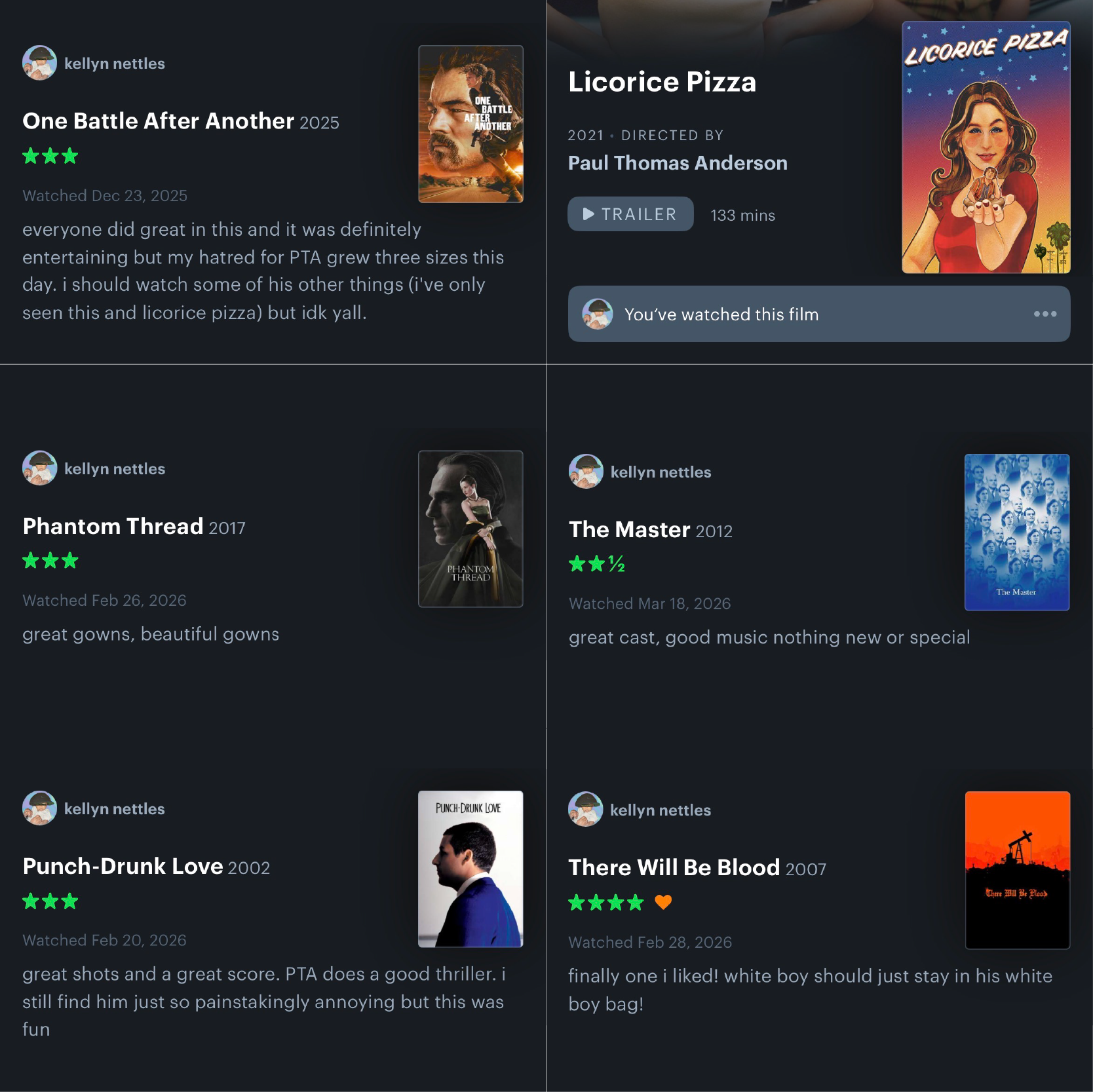
Before viewing Licorice Pizza, I was excited to finally understand the hype about Mr. Anderson. Unfortunately, I never got to that level of understanding. Following the viewing of what lives in history as the worst movie I’ve ever seen, I let my friends, loved ones, and Wikipedia guide my continued engagement with Mr. Anderson’s work. With every subsequent film I watched, I wanted him to prove me wrong. I would have loved for everyone to have been right when they said his earlier projects were better (I did find one I liked!)
In truth, I feel that my reviews are generous. A lot of them are three stars because broadly I can only seem to muster three positive things about what I’ve seen:
- His visual style is dynamic and fades easily into almost any background.
- The scores of his films create a haunting energy that helps drive almost every slow plot.
- His cinematography choices are interesting.
Beyond these three pieces of enjoyment, there was nothing really strong for me to call out with joy.
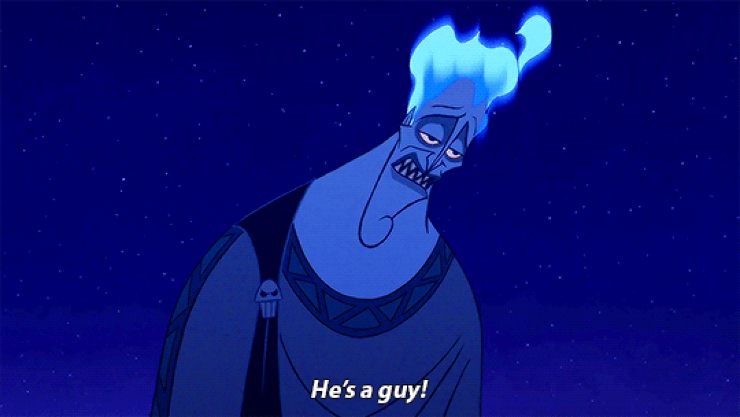
“HE’S A GUY!” —Hades, Hercules
Study
I have not found a single ounce of proof that Paul Thomas Anderson is not just another misogynistic, implicitly racist white man benefitting from the nepotism that undoubtedly shaped the success of his career. Nepotism, you may ask? Yes! I answer! His father was voice for ABC! He subscribes to all of the norms of patriarchal, capitalistic hierarchy. As proof, I now present to you a real, actual line from Anderson’s Wikipedia page:
Anderson attended New York University for two days before he began his career as a production assistant on television, films, music videos, and game shows in Los Angeles and New York City. Feeling that film school turned the material into "homework or a chore", Anderson decided to make a 20-minute film as his "college".
One of my best friends and former roommates used to refer to dudes who would say some shit like this as a Jack Kerouac Boy, because a good way of confirming you’re interacting with a man like this is if his favorite book is On The Road by Jack Kerouac. Today, we’re more likely to hear folks describing this kind of behavior as “performative masculinity”.
Men who participate in this identity framework, contrary to their personal beliefs, don’t actually do anything to break out of or against dominant culture. They actively contribute to it. This is what makes them so infuriating: they really, really think that they are being different and/or provocative. They are too tapped in to their own navel-gazing that they haven’t even thought to consider that other people might offer similar, better, more nuanced perspectives on things they’re interested in. Because of their access to wealth, they don’t need to do much consideration on what other people might have to offer—they can pretty much get most of the things that they desire without really trying (except women, which I will discuss next).
I feel like I can almost guarantee that Paul Thomas Anderson has read and loved On The Road, but I’ll admit that this is didactic and beyond the point. This point is: while Mr. Anderson, and his fans, may feel that the movies he creates do work to move the needle in society, or to wake us up to some larger narrative, they really never are or do. Anderson’s ability to move the needle lies less in his work to push us forward and more in his audacity to create narratives that keep us stuck in the same old cycles of patriarchy and extractive capitalism.
One Battle After Another, Anderson’s most recent film and vapid foray into themes of activism, is revered as showcasing the hard reality of a revolutionary living in “post-revolutionary times.” Many viewers praised the movie for its poignant take that, huh, maybe that revolutionary lifestyle ain’t all it’s cracked up to be. It won the Academy Award for Best Picture at this year’s Oscars.
On the surface, one could see the movie as showcasing modern revolutionaries in a way that we haven’t really seen before. We could give the movie credit for its message of class and community solidarity, and how important community and family can be when standing up to systems of oppression.
If we take a deeper look, the movie is not only anti-revolutionary in its writing and politic, but anti-revolutionary in its development, creation, and aftermath.
Analysis — One Battle After Another (OBAA)
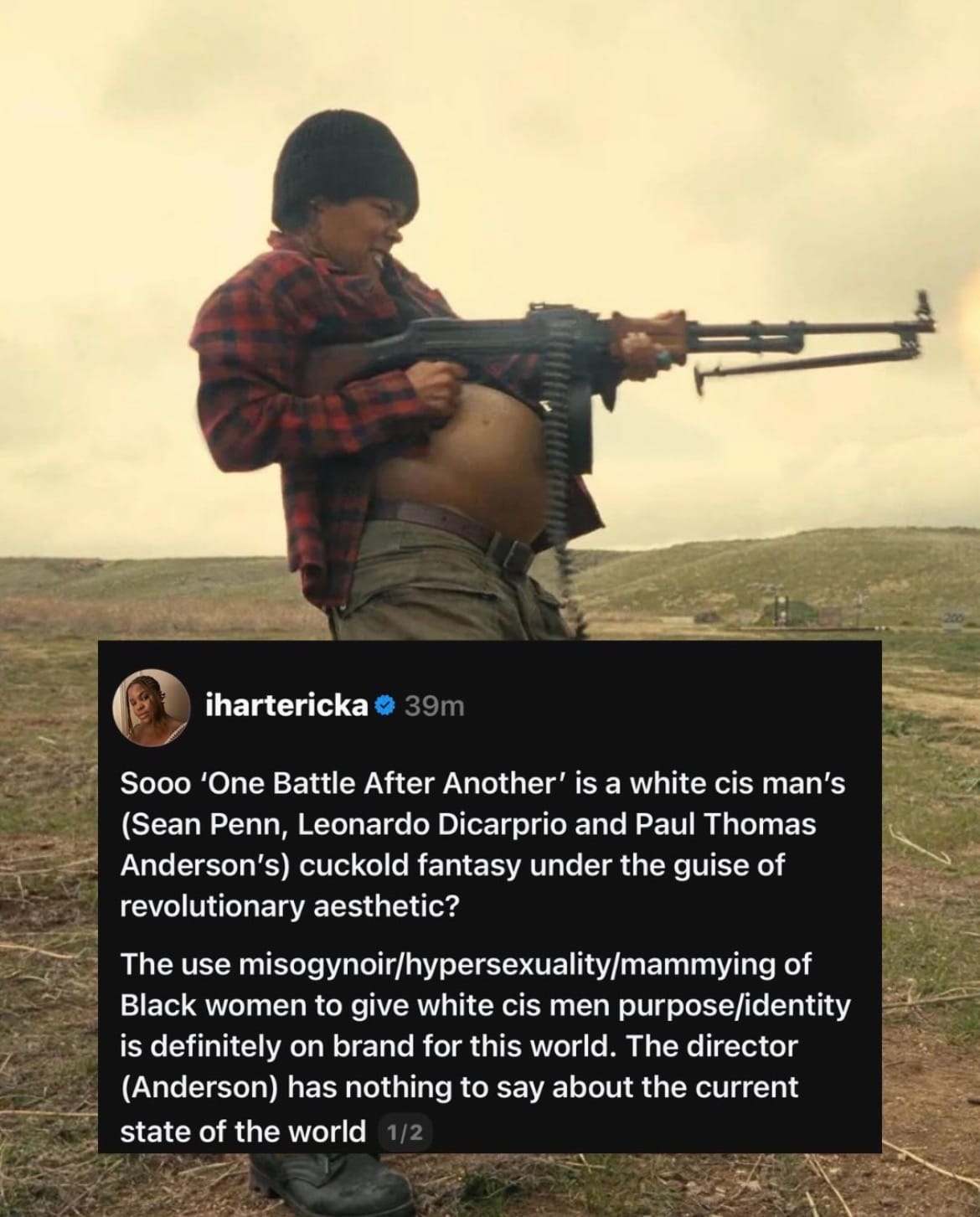
A notable amount of Black women have spoken out about their distaste for OBAA, laregly in part due to the film’s treatment and portrayal of Teyana Taylor’s character Perfidia. The fact that this kind of treatment has gone largely washed away by mainstream audiences speaks directly Anderson’s participation in the ongoing cycles of trauma, violence, and extraction he tried to speak on. Writer, producer, and director Brooke Obie eloquently speaks to this in her Substack review of the film.
Many of the people that I’ve talked to that loved this movie felt the need to make concessions around the misogynoir in this film. You may be reading this, knowing full well that you are one of the same people that put that aside. I’ll even acknowledge to my own putting it aside—I chalked up my discomfort around the treatment of Black Women in OBAA to something that perhaps I was “sensitive” to. I want all of us to seriously consider the impacts of this sort of disregard.*
Anderson’s mistreatment of Black women in OBAA is true to his form: In all of the movies I watched of his, Anderson portrays women as either crazy, docile, stupid, naive, or grating.** Anderson’s women are pets. Some of them are yappy and annoying, and some of them are a man’s best friend. All of them are pets, because we never get a real in-depth look at the intricacies that live within these women. They are flattened. Meaningless without the care from or neglect of our male lead.
Misogyny and misogynoir are, unsurprisingly, key characteristics of the Jack Kerouac Boy that Mr. Anderson happens to align with: He doesn’t really like or understand women, but he likes when he feels that he can wield power of them. He can only try to understand women as they relate to his idea of himself, and his gender —which is shaped by a misunderstanding of and discomfort with his own femininity. Disagree? Let’s look at what musician Fiona Apple (Anderson’s ex) had to say about him in an interview for The New Yorker:
In 2000, when she was getting treatment for O.C.D., her psychiatrist suggested that she do volunteer work with kids who had similar conditions. Apple was buoyant as Anderson drove her to an orientation at U.C.L.A.’s occupational-therapy ward, but he was fuming. He screeched up to the sidewalk, undid her seat belt, and shoved her out of his car; she fell to the ground, spilling her purse in front of some nurses she was going to be working with. At parties, he’d hiss harsh words in her ear, calling her a bad partner, while behaving sweetly on the surface; she’d tear up, which, she thinks, made her look unstable to strangers. (Anderson, through his agent, declined to comment.)
(Salaciously, he is also in a long-term partnership with Maya Rudolph, in which they have four children and she refers to him as her husband but they remain unmarried. I’m NOT the one to vouch for traditional marriage and relationships, but while I’m being a hater I’m going to take this opportunity to assume the worst!)
Where OBAA’s portrayal of Black women left me feeling uncomfortable and disrespected, I felt the most enraged at the film’s portrayal of immigrant protests and community activism. Initially it came from a stubborn and presumptive place: to be the film’s portrayals of these actions were shallow. They made if feel clear that Anderson had never actually been to a rally for immigrant rights, if he even really gave a fuck in the first place. I was willing to accept that I had internal bias against the man, but I was then made aware that Anderson had homeless encampments in Sacramento cleared in order for him to film parts of this movie.

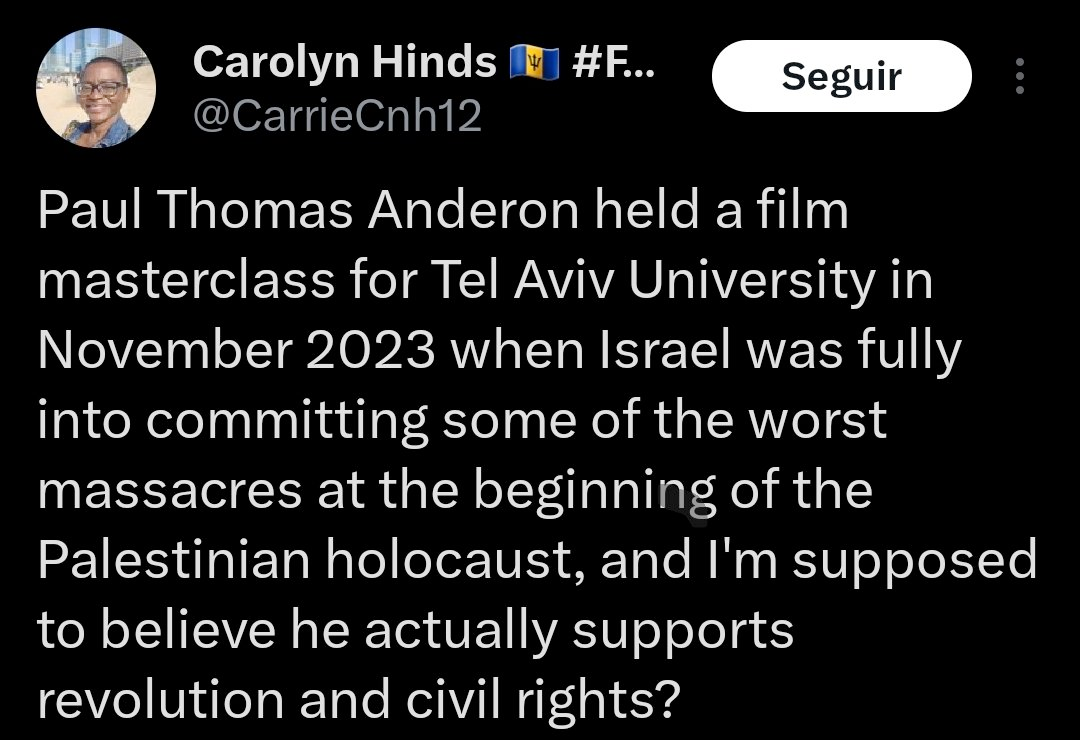
I also learned that Anderson made this movie seemingly right after holding a film masterclass for a university in Occupied Palestine, and chose Leonardo DiCaprio, a man funding a luxury hotel in the area, to star in the project as an revolutionary in hiding.
If the folks who are supposed to be presenting us award-winning commentary on revolution support the occupation of Palestine, does the movie’s commentary on revolution really speak to excellence in craft? Or does it speak to popular society’s need for self-aggrandizing shame without tangible change? What does it mean when the director of said film accepts his awards by saying he’s “not a politician, he’s a filmmaker” ? How does that inform the intent behind the film? How does this inform our progression towards breaking out of capitalist structures, when we’ve got folks in our communities—leftists, feminists, even abolitionists—raving praises about this terrible piece of revolution porn just because it’s entertaining?
** It’s frustrating to me that to be still asking this in 2026, almost six years exactly since the murder of Breonna Taylor, 20 years after the start of the Me-Too movement, and in the midst of increasing abuse allegations from the likes of Jeffery Epstein and his mixed company. Why is it so easy for us to disregard misogyny and misogynoir?*
*** UNLESS they are The Special™ Woman. A Paul Thomas Anderson Special™ Woman is NOT like other girls. She, unlike the others, can withstand the terror, neglect, or torture from our male leads. She stands on her own two feet. Our male lead will always find a way to break her, but she will continue to come back to him.*
Conclusion
I kindly beg for us to reconsider our attachments to one Paul Thomas Anderson as a groundbreaking director. I hope the explanations and evidence provided above allow you to see why. There’s a time and a place for folks like Mr. Anderson—our Jack Kerouac Boys. When they’re able to “be free,” they produce some of their best work.
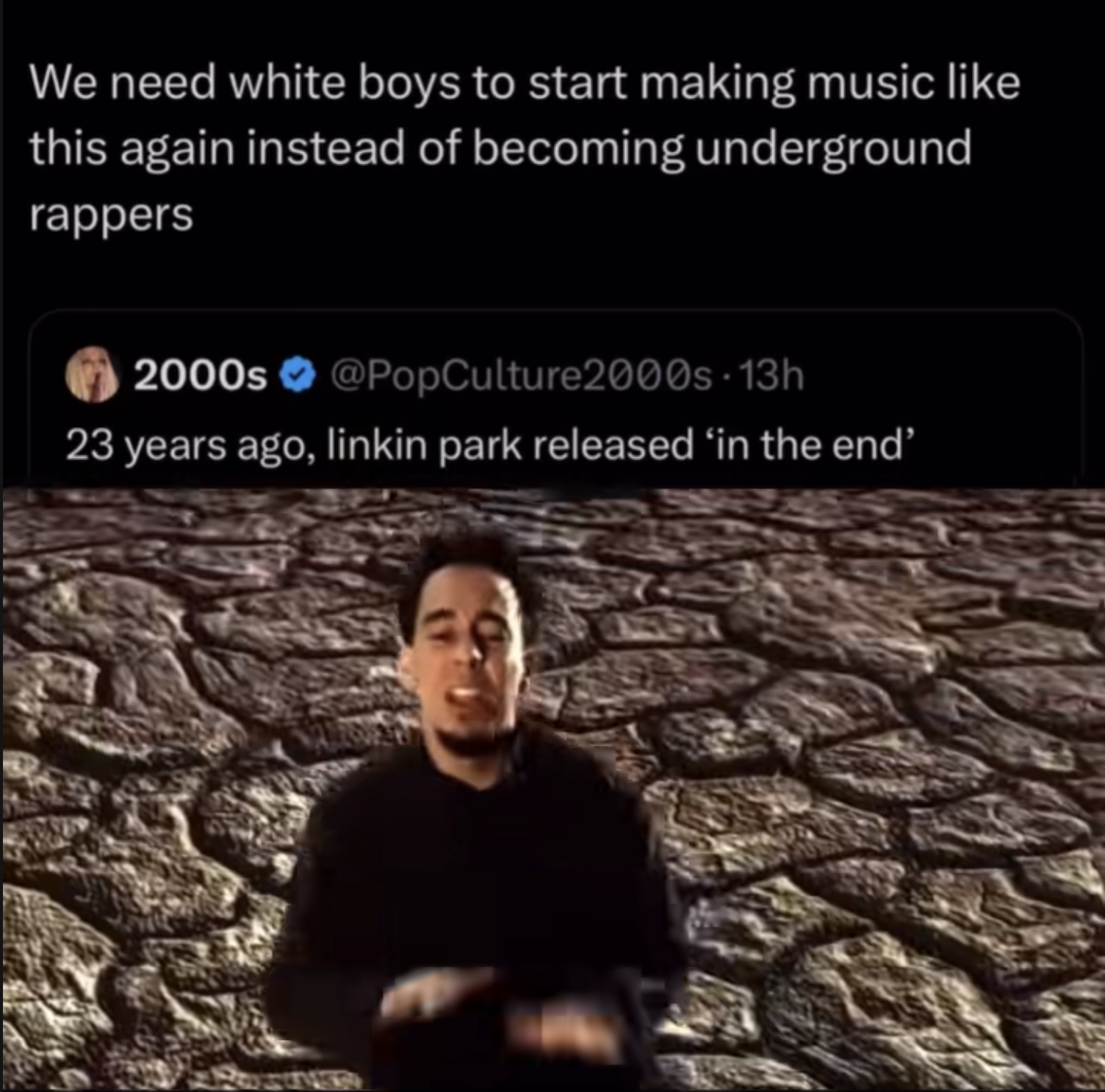
Colloquially on the internet, folks have started saying things like “white boys need start making music in the garage again,” as a nod to some of the great Alternative Rock songs that came out of white men in the late 90s and early 00s. I’d like to offer the same sentiment to Mr. Anderson: stick to what you know. Of all of the movies that I watched, There Will Be Blood was by far my favorite. I’ll tell you why: we were talking about white on white crime!
There were no women involved or people of color! The movie was about white men fighting for OIL AND POWER! The movie was an adaptation of a novel by Upton Sinclair, noted racist! Anderson was in his lane, and I was able to sit back and enjoy as a viewer. I wasn’t expecting anything but angry white men doing what they do best, so I was able to enjoy angry white men doing what they did best.
Let this be a lesson to us all.