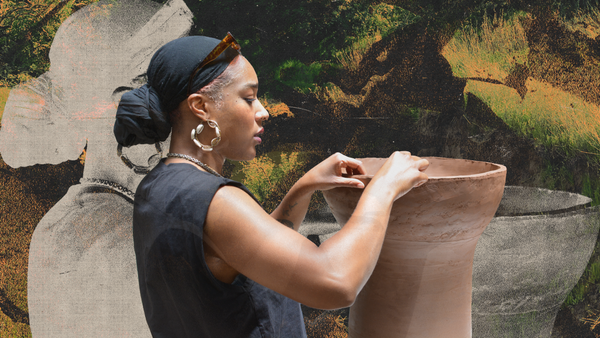
"Is God Is" and "Sinners": An offering to the Ibeji Twins
What if “Sinners” and “Is God Is” belong to the same spiritual universe? Reading the films through the Yoruba Ibeji belief system reveals a meditation on ancestry, protection, Hoodoo, and Black futurity, where twinhood becomes a philosophy of survival.

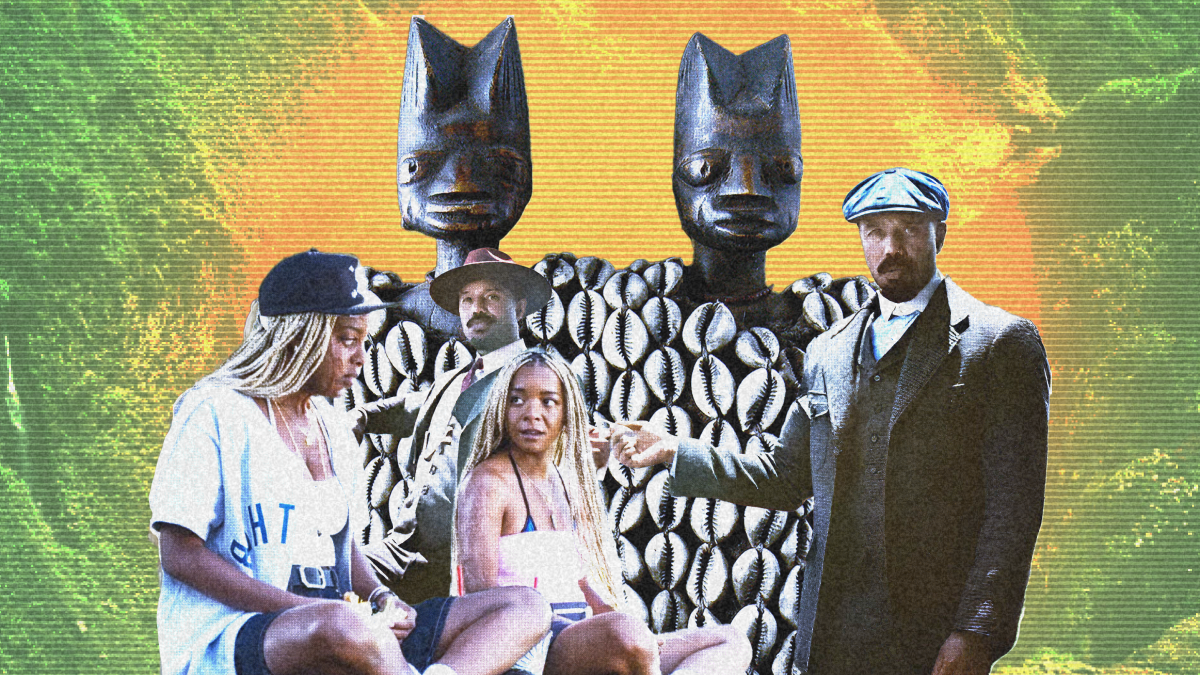
Twins are having a moment in cinema right now. Although they have long been held sacred in Yoruba cosmology, the spiritual and philosophical resonance of twinhood has become increasingly visible in contemporary media. Ibeji, the Yoruba word for the inseparable two, refers to the twin Orishas in both Santeria and Lukumí spirituality. I first became familiar with the tradition through Ibeji Botanicals, a twin-owned apothecary that opened a storefront in my neighborhood just over six months ago.
In Yoruba society, twins hold special spiritual meaning and their birth is held as a time for great praise. The first twin is traditionally called Taiwo, which means “having the first taste of the world.” The second twin is called Kehinde, meaning “arriving after the other.” While Taiwo may have come first, Kehinde is said to be the older of the two twins: after Taiwo is born, and assesses the scene on Earth with a curious worldview, Kehinde is able to come into the world with a more careful and intellectual presence. Three days after the birth of twins, a local Ifa priest will visit them, dispelling any evil spirits that surround the twins and advising their mother on how to best care for them: the clothing they should wear, foods they should eat, and even animals they should avoid.
It is believed that twins share a soul, and that if one of them dies a significant imbalance is created for the other. Ibeji are often applied here as small, carved wooden figures created to sub in for the deceased twin. Said to bring prosperity, blessings, and protection to those who care for their wooden figures, Ibeji also represent duality and the importance of life, love, and ancestry.
The spiritual significance of Ibeji offers an interpretive lens for two recent films (either openly or through themes) exploring African American spirituality and ancestry: what began with the Oscar-award winning performance by Michael B. Jordan in Ryan Coogler’s Sinners has now led us to the more recent performances by Kara Young and Mallori Johnson in Is God Is, the play-turned-movie by (and directorial debut of) Aleshea Harris. I would like to propose the two films as a double feature in offering to Ibeji: where Is God Is serves as the future-facing sequel to the world that Sinners leaves behind.
[Spoilers Ahead! Read at your own risk!]
Blood of my Blood
In Is God Is, we witness the tale of two sisters, Racine and Anaïa, baring the (literal) scars of domestic violence and abuse. After reconnecting with their estranged mother, who they refer to as God (played by Vivica A. Fox), the twins are sent on a journey to fulfill their mother’s death wish: kill the man who harmed all of them—their father.
Sinners, now a well-known box office hit, tells the story of the Smokestack Twins and their little cousin Sammie. The bootlegging duo’s brilliant return to Mississippi is interrupted by ravenous vampires, who turn the twins new juke joint into a bloodbath after Little Sammie’s spiritual music performance.
In both films, the twins represent two sides of the same coin, a duality reinforced by costume design. In Sinners, Stack (eventual vampire) dons red, while Smoke wears blue, perhaps signifying the virtuous way in which he dies (not bitten). Racine and Anaïa can be seen dressing along a similar color scheme in Is God Is and **reflecting similar values: Racine, pictured below in pink, is our more vengeful twin (who dies alongside her father), while Anaïa, in blue, is our twin who makes it out of the fire the second time around.

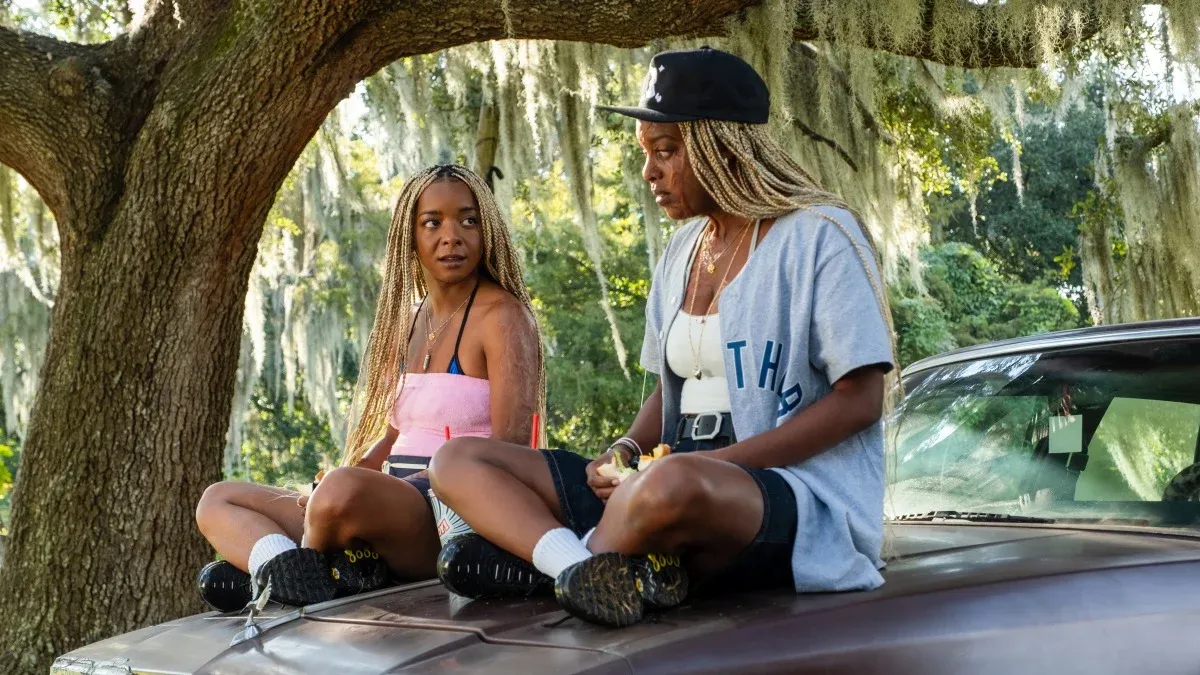
The moral balance we strike with each of these twins harkens back to Ibeji as symbols of protection. It’s also what makes these films a perfect pair: their shared desire to protect something (or someone) that is being physically attacked at the time. As our first film in the duology, Sinners asks questions about how to protect Black culture, specifically from whiteness. Is God Is asks questions about protecting Black lineage.
Starting with the broad approach, the Smokestack twins illustrate the tension between the sacred and ancestral practices of Black culture and the “fellowship and love” of a diverse community. As Àrokò member Aishatu writes in her piece on the film:
To casual viewers, Sinners is simply a stylish vampire movie set in the Jim Crow South. To those with eyes to see, it's a radically honest portrayal of America's ongoing racial parasitism, where Black culture is consumed while Black bodies remain disposable.
This tension comes to a head in one of the few moments in the movie where we see Smoke struggle with his virtues: after Stack is turned into a vampire (by his white-passing love interest), he tries to convince Smoke to join the rest of the vampire gang. Smoke almost gets convinced (only to be stopped by his Hoodoo practitioner love interest).
As we jump into the future, we find Racine and Anaïa struggling more with the morals of violence, namely revenge, within the black home and the black family in Is God Is. The tension between the sisters builds at the line of rage versus acceptance. Since Anaïa’s skin grafts cover half her face, she grew up receiving more vitriol from strangers than her Racine, whose grafts were mainly on her arm. Because of her visible differences, Anaïa’s rage is quiet and internal—an act of self protection—while Racine’s rage is violently external, taking on the role as her sister’s keeper and bodyguard. This becomes a key dynamic between the two, with Anaïa almost leaving Racine behind after she broke a promise not to kill any more people beyond their father.
When watched in tandem, both films raise questions around reparations: What are we owed? What do we owe? How do we get it? As an offering to Ibeji, how can we protect what is sacred about our culture, our bodies, and our homes?
Roots of Origin
Elements of Hoodoo thread through both films, making Is God Is feel less like a separate story and more like an afterlife imagined through the cosmology that Sinners introduces.
Smoke’s love interest, Annie, is a Hoodoo practitioner, portrayed as a spiritual woman: she owns her own apothecary, we see her working with bones, and she creates a mojo bag of protection for Smoke, who only dies once he removes the bag from his person. Annie also serves as our narrator for the movie’s opening sequence, where we learn about storytellers from across cultures. She grounds the film in spirituality from start to finish, when she reappears as the angel that guides Smoke towards the afterlife.
Seen through this lens, this is where we, as the audience for both films, can imbue some ideas of Afrofuturism. If we can imagine the area of Clarksdale, Mississippi almost 100 years into the future, blending common themes and elements of spirituality with newness and freshness, we might end up with something like Is God Is, where the twins seem to communicate telepathically and energetically, their souls imbued with a sort of spirituality that becomes evident to the audience but not to the folks they interact with on screen.
We might end up somewhere like God’s house, where there are dark green walls with windows covered by dark green lace curtains. Where God sits in bed, surrounded by braiders finishing her knotless micro braids, hands adorned in gold rings, bracelets, and green acrylics. Where God’s face wrap is lined with beads in floral patterns matching the lace coverings around the house. True to her name, God’s house becomes our sacred space in Is God Is, the spiritual glue that holds the rest of the movie’s surrealist elements together.
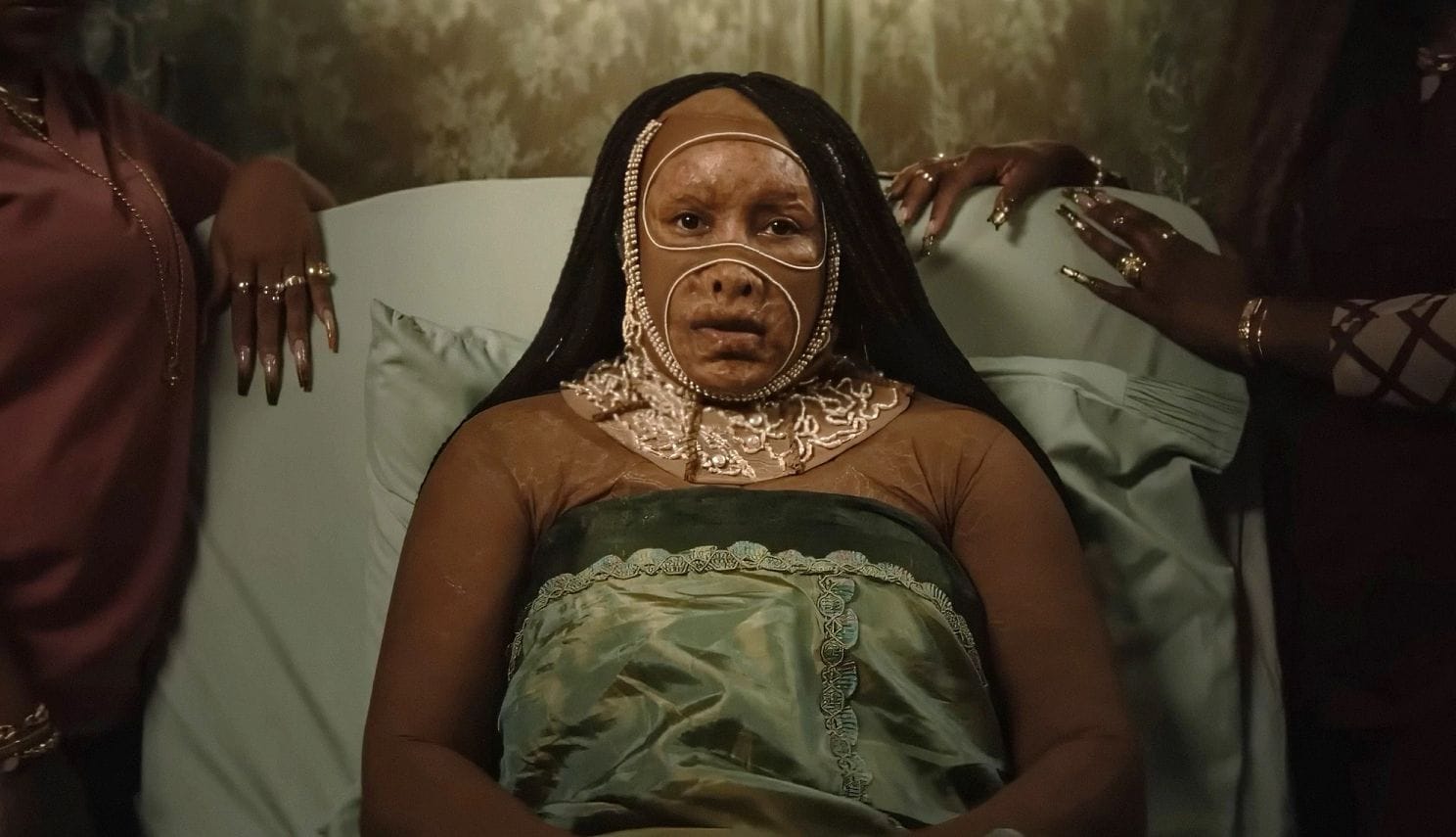
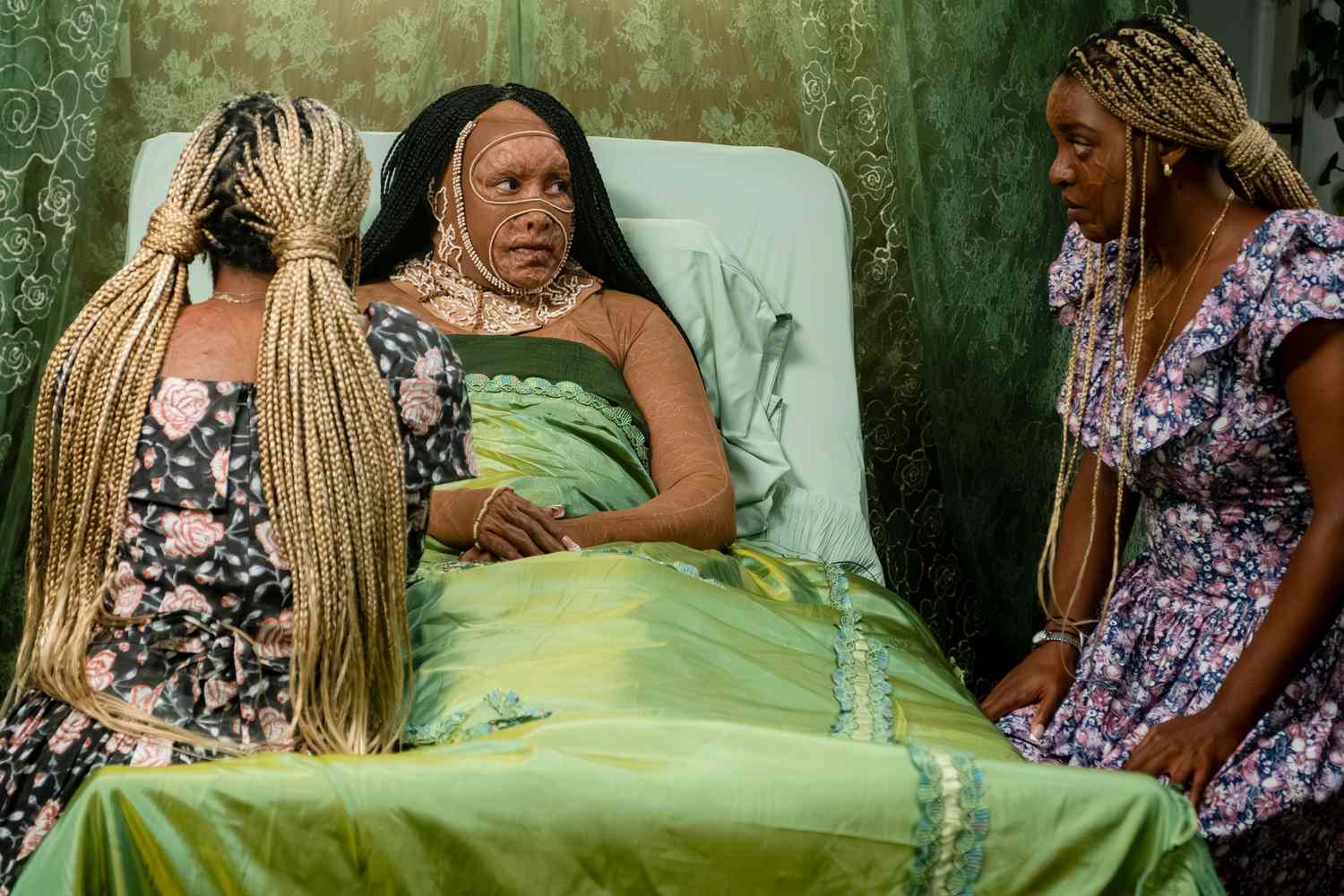
(ON THE LEFT) God, played by Vivica A. Fox. Source: AARP; (ON THE RIGHT) God talks to Racine and Anaïa. Source: IMDb
Both films take place in the American South, where Hoodoo emerged through the convergence of West African traditions and the realities of enslavement. As Hoodoo can be said to have Yoruba influences, this double feature offering can uplift Ibeji while also serving as a show of gratitude towards the ancestors whose spiritualities became a blend of roots from which they came from and herbs from where they arrived.
An Aside:
My two favorite things about both films are the lighting and caption design. I would hope that Joshua Darden’s Freight Collection was used for both the time skip in Sinners and the communication between the twins in Is God Is. Either way, these subtle points of design really imbue both movies the slightest sense of belonging to the same spiritual universe.
Thank you to Àrokò member Kristen Stain and their Madrina for guidance on spiritual traditions.
References:
Yoruba Customs and Beliefs Pertaining to Twins by Fernand Leroy, Taiwo Olaleye-Oruene, Gesina Koeppen-Schomerus and Elizabeth Bryan.