Àrokò Monthly Roundtable #03
In a world of fast outputs, not everything is meant to last. This roundtable begins with a simple question: what is actually worth our time, our care, and our attention?


“Slowcraft is about protecting judgment.”
Each month, we gather members of the Àrokò Cooperative for an unfiltered roundtable, giving you a temperature check of our take on design as it moves through art, music, politics, technology, and everyday rituals of taste. We ask sharper questions about what’s being made, who it’s for, and what it’s really doing in the world.
AISHATU
There are three questions we’ll be exploring together. What does quality mean when output is fast and abundant? How does the pressure to produce faster affect crafting cultural intelligence? And what kind of work requires time, friction, and attention? Some of you are actively producing within this philosophy, so I’m especially curious what slowcraft means for you. Let’s start there. Who wants to go first?
ZARIAH
When I think about quality, I immediately think of fast food versus actually cooking in the kitchen.
Fast food is convenient and immediate. It gives you quick results. But when you’re cooking, you’re crafting. You’re in your own space. You’re putting your love into it. There’s flow. There’s sometimes silence.
And it’s more nourishing. Fast food might make you feel full, but later you’re still hungry. That’s how I think about craft right now. You can go online and buy press-on nails for six dollars. But are you getting the quality you would if you went to someone who designs and customizes them, who puts their sweat and love into it?
Yeah, it costs more. It takes longer. But when I go to my Black nail tech, there’s a communal aspect. We craft it together. There’s reciprocity. It becomes long-lasting. It’s not just transactional.
With fast food, you go through a drive-through. One interaction and you’re done. When someone cooks for you, you build a relationship. You create a connection.
AISHATU
What does quality mean, especially when output is fast and abundant?
I want to anchor us in how we at Àrokò define quality. We look through three lenses.
One is storytelling. For us, quality means creating work that tells a sustained story. It carries context, continuity, and coherence. It also honors what existed before the artifact and what will come after it.
Another important aspect is cultural intelligence. Here, quality is deeply anchored in research, reflection, and a real understanding of systems and communities.
The final piece is craft, which is also what we are focusing on in this roundtable and in this idea of defending slow craft.
Quality really emerges from time spent and from an iterative approach to making. It comes through revisiting, refining, and developing outputs over time.
In the world we are living in now, where there is an abundance of cheap output and what people often call ‘AI slop,’ quality becomes a kind of filtering mechanism. It helps us decide what to keep and what to reject. It asks what is actually worth returning to again and again.
Quality is about cultural resonance. It is about whether what we produce holds meaning and continues to matter over time.
SHAKEIL
Zariah’s food metaphor and what you just said both point to something that lasts.
A dopamine hit, whether it’s an AI-generated video or fries from Shake Shack, gives you something immediate. Then you feel nothing. Or you feel bad.
Quality sticks with you. It has a lifespan beyond that first moment of interaction.
The tension now is that not everyone cares about that. The immediate interaction is enough. Get the eyeballs, move on. So quality becomes almost a niche value. Meanwhile, most people are absorbing fast, abundant output as their primary way of engaging the world.
AZEEZ
For me, slow craft is not about resisting speed or technology. It is about protecting judgment in a world where output is fast and abundant, and where AI has made execution very cheap.
Quality shows up in intent. It shows up in what we choose to include, and just as importantly, what we choose to leave out. It shows up in whether the work carries real cultural understanding.
The pressure to move fast flattens nuance, especially cultural nuance, which is often the most important part of the work. That is where craft starts to get compromised. Some work simply requires friction. Work dealing with people, identity, systems, power — that can’t be rushed.
So I’m less interested in slow versus fast, and more interested in where slowness is non-negotiable. What deserves care? That’s a responsibility tied to lineage and tradition, to what we choose to pay attention to and what we choose to carry forward.
And to your point, if something is executed quickly but the thinking behind it was slow, intentional, and grounded, then that is what matters. The speed of the output is less important than the depth of the thinking that shaped it.
KELLYN
I’ve been thinking about the tension between speed and efficiency.
My first instinct was: can you have great quality that is fast and abundant? I don’t think so. Zariah, you mentioned flow state, and that made me reflect on what that actually means. It’s not about producing a bunch of stuff quickly. It’s about locking in. Focusing. Iterating.
Quality reflects care. Pressure is the keyword here. When you’re creating under pressure, are you doing it because there’s demand? Or because there’s intent?
The question becomes how we stay connected to why we are doing something in the first place. The balance between care and efficiency, that’s where craft lives.
KRISTEN
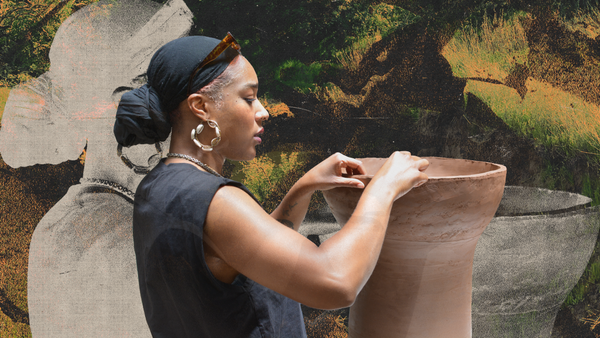
I keep thinking about material. In ceramics, there’s no alternative to spending time with the material. I’ve made so many pinch pots. I’ve fumbled through most of them. Recycled them. But when I teach my students, I can make one quickly, because I’ve committed the movements to memory. I have a relationship with the clay.
Things that lack quality often omit consideration. It’s not just whether a cup has a handle or a foot. It’s whether you stopped to consider what that choice means to the person who will use it. Or what it means in context.
Speed of expertise is different from speed of indifference.
MAHIE
When I think about defending craft, I think about TLC. Tender love and care.
But also permission to make mistakes. To not see mistakes as failure, but as redirection.
Regenerate, or ‘rebloom,’ feels like a different way of thinking about it. When Meron and I were learning about the weaving process and the loom, there were so many layers of community and relationship building involved. It was also about learning from elders, taking time, and really understanding different cultural practices.
That’s where the idea of slowness feels important. You have to build trust and mutual understanding before you can even begin to create, especially in a collaborative context.
So what’s coming up for me is how we make space for that kind of process?
SHAKEIL
This connects to the last question. What kind of work requires time, friction, and attention?
Work that needs a life beyond the transaction.
So much right now is made for the sale, such as content or fast fashion. Once the transaction is complete, it has no purpose. No longevity.
If something is meant to live beyond that, it needs care baked into it.
AZEEZ
It’s kind of a repositioning. What I was trying to say earlier is that speed is not the enemy. Unexamined speed is. The danger is not necessarily an abundance of output, but a collapse of discernment. That’s what we’ve been circling around.
Slow craft becomes a counterweight. It is a way to preserve intention, cultural intelligence, and co-responsibility, which is what Mahie was getting at.
So when systems reward velocity over understanding, it becomes really incumbent on us to apply more integrity in how we uphold those processes of craft and practice, and in the way we approach the work.
MERON
As we talk about quality, I keep thinking about output and how often people assume that if they are paying for something high quality, they can treat it however they want and it will last a long time. There is this expectation that quality means something is almost indestructible.
Going back to the weaving Mahie mentioned, that experience made me realize that there are different layers of quality. Something can be well made, but it still requires care in return. You cannot expect it to hold up if you are not taking care of it.
With woven fabrics, for example, I sometimes struggle with my rings or even an uneven nail snagging the material. But that does not mean the weaving itself is low quality. It means I have to move differently and be more attentive.
My grandma has dresses that are over 30 years old and they still look beautiful. That comes from how she handles them. She is careful, organized, and intentional.
So what I keep coming back to is that quality does not mean indestructible. It is also about the care and love you give in return. Quality requires reciprocity.
SHAKEIL
That’s a good point. It also makes me think about how you can apply a slow craft or quality mindset to something that may not have originally been made with that intent.
For example, I love Uniqlo. In particular, the Uniqlo U collection and some earlier collaborations before that. I still have a number of pieces from those lines. They were definitely made with a higher level of quality than the usual baseline, but even then, they were probably not designed to last as long as they have. The reason they have lasted is because of how I have taken care of them. They have aged in a way that actually makes them feel higher quality than you might expect.
This is a bit of a shift, but something else that comes to mind when we talk about slow thinking and swift action is politics. I think many of us try to move with a principled political mindset that is shaped by slow, careful thinking about the issues around us. At the same time, a lot of the problems we see come from people being reactionary, moving too quickly, and relying on fast thinking instead of taking a longer-term view.
So in that sense, craft is also about how you shape your worldview and develop your ideology over time.
AZEEZ
Slow craft, or slow thinking, allows us to interrogate inherited logic and inherited ways of thinking. It helps us ask what these systems are doing, who they benefit, and whether they still serve us. From there, we can start to course correct, make new decisions, and improve on what exists.
That feels incredibly powerful because so many of the systems we are living within continue to oppress and antagonize people. Yet many are participating in or stewarding those systems without fully understanding how or why they operate.
You can call someone out for harm, and they might respond by saying they are not racist, for example. But the reality is they may still be upholding a system they have never fully examined, one that continues to produce harm regardless of intent.
So when we take the time, individually and collectively, to really interrogate our ideologies, our culture, and the systems we contribute to, we create the possibility for change. We can begin to align what we produce with what we actually intend.
Coming back to quality, it becomes about alignment. It is about clarity of purpose and making sure our outputs truly reflect the values we say we hold.
MICHAEL
Are we assigning artisanal ethics to things that don’t deserve it?
We’ve been talking about both digital and physical products, but so much of what exists in the 21st century is designed simply to be produced and sold.
At what point do we just let those things be what they are? It’s all well and good to preserve something like a Uniqlo piece, but I would argue that sometimes that effort might be misplaced. In the same way we’ve been talking about maintaining systems without interrogating them, if we apply a craft mindset to everything indiscriminately, we risk misdirecting our care. It becomes a question of whether we’re investing attention in things that actually merit it.
Being in Mexico right now has made that contrast really visible to me. Just walking around, you can clearly see a distinction between things produced for consumption and things that carry cultural resonance and craftsmanship. There’s a kind of acceptance that not everything needs to be treated as craft.
We’re well past the point where everything can or should be approached that way. How do we decide where that level of care and intention is actually needed? We should be intentional with our effort, rather than feeling compelled to apply it everywhere, especially to things that don’t warrant that depth of engagement.
MERON
Michael could give an example of something that isn’t worth pouring into. What does that look like?
MICHAEL
Not to put Shakeil on the spot, but take Uniqlo, for example. There’s so much that’s just basic, disposable clothing. Do you really need a T-shirt like that to be a $300, perfectly crafted Egyptian cotton piece where every detail is elevated? Probably not. There are better places to put our time and effort.
Especially for us as designers, when we think about products, whether digital or physical, it raises the question of where that level of care actually belongs. Take something like socks or underwear. Are people darning socks in the 21st century? Not really. And that’s because most of those items are not made in a way that justifies that level of attention and repair.
On the other hand, something like the dresses or woven pieces you inherited from your grandmother, those are the things you invest back into. Those are worth the care.
Part of this is about developing the ability to distinguish between what truly merits that level of attention and what doesn’t.
MAHIE
Caring for smaller things builds the behavior people need to eventually engage with higher-quality or more artisanal pieces.
Not everyone starts from the same place. Habits create pathways. If I take care of my Pilates socks, I’m practicing stewardship. That scales values over time. And people will get there at their own pace. That is part of how broader change happens.
AZEEZ
Respect is baseline. Nurturing varies by proximity.
Everything deserves dignity. Not everything gets equal depth of investment.
KRISTEN
And everything has ashe. Even something cheaply made carries energy.
For example, if I have socks with holes in them, maybe I am not repairing them, but I can still think about how to give them a next life. Maybe they become something for my dog, or I recycle them properly. It is about being intentional with how I move things through their lifecycle.
We exist in a material world, and a lot of what we interact with is not made to last. But we are still in relationship with those materials, so we have to decide how we handle them.
And that does come down to the individual. For example, I have little plastic dinosaurs on my desk. I like them, and I take care of them in my own way. I am not investing a huge amount of energy into preserving them, but I am also not treating them as disposable. I am just being mindful within reason.
MICHAEL
I do not disagree with any of this. For me, it connects to something like The Life-Changing Magic of Tidying Up. One of the key ideas there is that you have to make decisions about the objects in your life. You identify what you value, what you want to keep, what sparks joy. And for the things that do not, it is not about discarding them carelessly. You acknowledge them, you recognize their role, and then you let them go.
But ultimately, this comes back to discernment. Yes, everything has ashe. Yes, everything is made by people. But we are finite. We have limited time, limited energy, and only so many hours in a day.
I still believe that we cannot, and should not, apply the same level of care and attention to everything. If we do, then the things that truly deserve that level of care will not receive it. If you are spending your energy polishing plastic dinosaurs on your desk, then you are not investing that same attention into the work that actually calls for depth and intention.
So yes, if the Pilates socks spark joy, then care for them. That is valid. But we should also be honest about what they are. They are still mass-produced items, shaped by the realities of labor and production at scale. They do not inherently merit the same level of care as something deeply crafted or culturally significant.
And I think that is part of the responsibility, especially for those of us working as designers or thinking critically about the world. We have to be able to make those distinctions. To say clearly, this is worth deeper investment of time, energy, and care, and this is not.
That is what discernment really looks like in practice.
SHAKEIL
That brings it back to development versus output.
When Kellyn was designing the Black Clay graphic, the thinking was slow. The execution was quick. And when they wanted to keep tweaking it, we told them not to, because that graphic’s purpose was to facilitate a transaction. Their deeper energy was needed elsewhere.
That idea of discernment is key here.
AISHATU
Slowcraft is also about what we bring into our bodies and communities.
Many textiles contain toxic chemicals. Hormone disruptors and other health risks. Most people never ask what’s in the fabrics closest to their skin. For example, many textiles, including a significant portion of underwear on the market, have been found to contain toxic chemicals that can disrupt hormonal systems and pose real health risks. Most people never question what is in the fabrics closest to their skin.
Choosing to slow down allows us to ask those questions. It helps us understand materials, recognize their impact, and prioritize health and well-being over speed.
So it really becomes a lifestyle choice, one that challenges the norms of fast, extractive production.
A lot of what we have been circling around today is that slow craft shows up in relationships. To materials, to communities, and to the traditions that came before us. Those relationships cannot be shortcut. They require time to develop.
Friction is part of the learning. It helps us understand the limits of a material and the responsibility that comes with making something that enters someone else’s life.
AZEEZ
There is a quote from Jerry Lorenzo that stuck with me. He said he grew up hearing, ‘the way you do one thing is the way you do all things.’ I think about that in terms of relationships. We have close friends and family, then a wider community, then people we interact with more loosely. The level of attention and energy we give each relationship is different.
But there is still a baseline. Ideally, we treat everyone with respect. What changes is the depth of care and the level of nurturing, depending on how close that relationship is to us.
The same applies to objects, to craft, and to care. When Kristen talks about everything having ashe, I hear that as everything deserving a baseline level of respect. But the amount of attention and care we give depends on how close that thing is to our center, to our values, and to our lives.
So it is not about treating everything equally. It is about being consistent in our approach, while being discerning about where we invest more deeply.
KELLYN
I think there is something important about emphasizing slow development. That is really where intent gets shaped. It informs the intent of the producer, and it is where cultural intelligence comes into play. It is also where craft begins to emerge.
Slow development often means research, asking where things come from, and taking time in the process. Even thinking about the Black clay graphic example, slowness showed up in the early stages. It was about choosing the right images, considering what direction to take, and figuring out what would communicate clearly. That was the care in the process.
Where I got a bit too deep into it was at the end, trying to add an extra layer that was not necessary. That is a different kind of impulse.
This connects to the distinction we were making earlier. Quality and care at the output stage are about how something is finished or produced. But slowness, friction, and attention really belong to the development stage.
Even when we talk about something that feels cheaply made, there was still a point of origin that involved care and development. The first versions of those objects likely came from necessity, with a lot of trial and error. Someone had to figure out how to make that thing work.
I think about a friend who knits. They once made a very complex scarf as a gift and said they would never do that again because it took so much time and effort. But they still make other things like socks because they have already developed that skill and process. It becomes more natural over time.
So I guess what I am getting at is that development is where slowness really matters. It allows you to build understanding and intention. Then, when you move into production, you can be more efficient without losing quality, because the thinking has already been done.
MICHAEL
This discussion about speed and quality reminds me of one of my favorite sushi restaurants in San Francisco. It’s run by a second-generation sushi chef who basically grew up in his father’s kitchen.
He’s one of the fastest chefs I’ve ever seen. His knives move so quickly it’s almost hard to follow, and the food is incredible. So for me, it challenges the idea that speed and quality are always at odds.
But the question is, where does that speed come from? It comes from slowness. It comes from years of practice, care, and deep attention to the craft. That level of speed is built on a foundation of discipline and repetition.
And I think that’s very different from something like fast fashion. One is speed that emerges from mastery, and the other is speed that often bypasses care altogether.
That distinction matters.
There is a kind of speed that comes from quality, and there is a kind of speed that comes from the absence of quality.
And we cannot confuse the two.